

Building more sustainable cities does not rely only on buildings, transport systems or environmental policies. It also requires everyday infrastructure that helps make public spaces safer, more accessible and more energy-efficient. At Sunna Design, we believe that solar public lighting can contribute to this transformation when it is designed according to the real uses of the site. Cycle paths, pedestrian walkways, parks, car parks, residential areas or access to transport: lighting plays an essential role in the quality, safety and continuity of public spaces. Through its projects, Sunna Design contributes to the United Nations Sustainable Development Goal 11: making cities and communities more inclusive, safe, resilient and sustainable.
A sustainable city is not only about reducing its environmental impact. It must also allow people to move around, access services, use public spaces and feel safe in their daily lives.
Yet in many areas, some spaces remain difficult to develop or secure. This is particularly true for areas located far from the electrical grid, connections between neighborhoods, pedestrian routes, greenways, cycle paths or the surroundings of public facilities.
These spaces bring together several challenges:
In this context, lighting becomes a real urban planning tool. It is not simply about adding more light, but about providing a precise response to a local need: making a route more legible, facilitating use, strengthening the continuity between spaces and improving quality of life.
In a sustainable city, the goal is not to multiply light points. The challenge is rather to design useful, controlled and adapted lighting.
Responsible public lighting must be designed according to several criteria: the orientation of the luminaires, the lighting level, the operating hours, the site’s level of use, the surrounding environment and the territory’s constraints.
This approach makes it possible to combine three priorities: user safety, energy efficiency and the limitation of light pollution.
Sobriety therefore does not depend only on the energy source. It also relies on the way light is used: in the right place, at the right time, with the right level of intensity.

In this context, light is not just a technical feature. It becomes a driver of use, safety and accessibility.
However, solar lighting is not an automatic answer to every project. Its relevance depends on the site, the expected lighting level, the available sunlight, the installation constraints and the uses to be supported. This preliminary analysis is what makes it possible to design a credible, effective and sustainable project.

Autonomous solar lighting can provide a relevant response when connection to the electrical grid is complex, costly or not well suited to the project.
By producing and storing its own energy, a solar streetlight can light certain public spaces without systematically extending the electrical grid. This autonomy can make it easier to deploy lighting solutions in soft mobility areas, isolated spaces or sites undergoing transformation.
In practical terms, solar public lighting can help to:
Sunna Design develops solar public lighting solutions designed to address the operational, environmental and social challenges of territories. Our approach is based on several key principles:
Energy autonomy adapted to the site
Solar solutions make it possible to light certain public spaces without systematically depending on the electrical grid. This autonomy is particularly useful for remote areas, specific pathways or projects where grid connection would be complex.
Sizing based on real uses
Each project must start from the needs of the site: the type of space to be lit, footfall, hours of use, the expected level of safety, environmental constraints and sunlight conditions.
Simplified deployment in complex areas
By limiting the need for trenches and grid extension, solar lighting can facilitate certain development projects, especially in already urbanized spaces, peri-urban areas or hard-to-access sites.
Controlled lighting and urban integration
Sustainable lighting is not necessarily more powerful. It must be useful, controlled and adapted. Luminaire orientation, intensity modulation, presence detection or time-based programming make it possible to light according to the needs of the site.

Solar lighting solutions from Sunna Design are deployed in a variety of contexts, illustrating the cross-cutting role of light in public spaces.
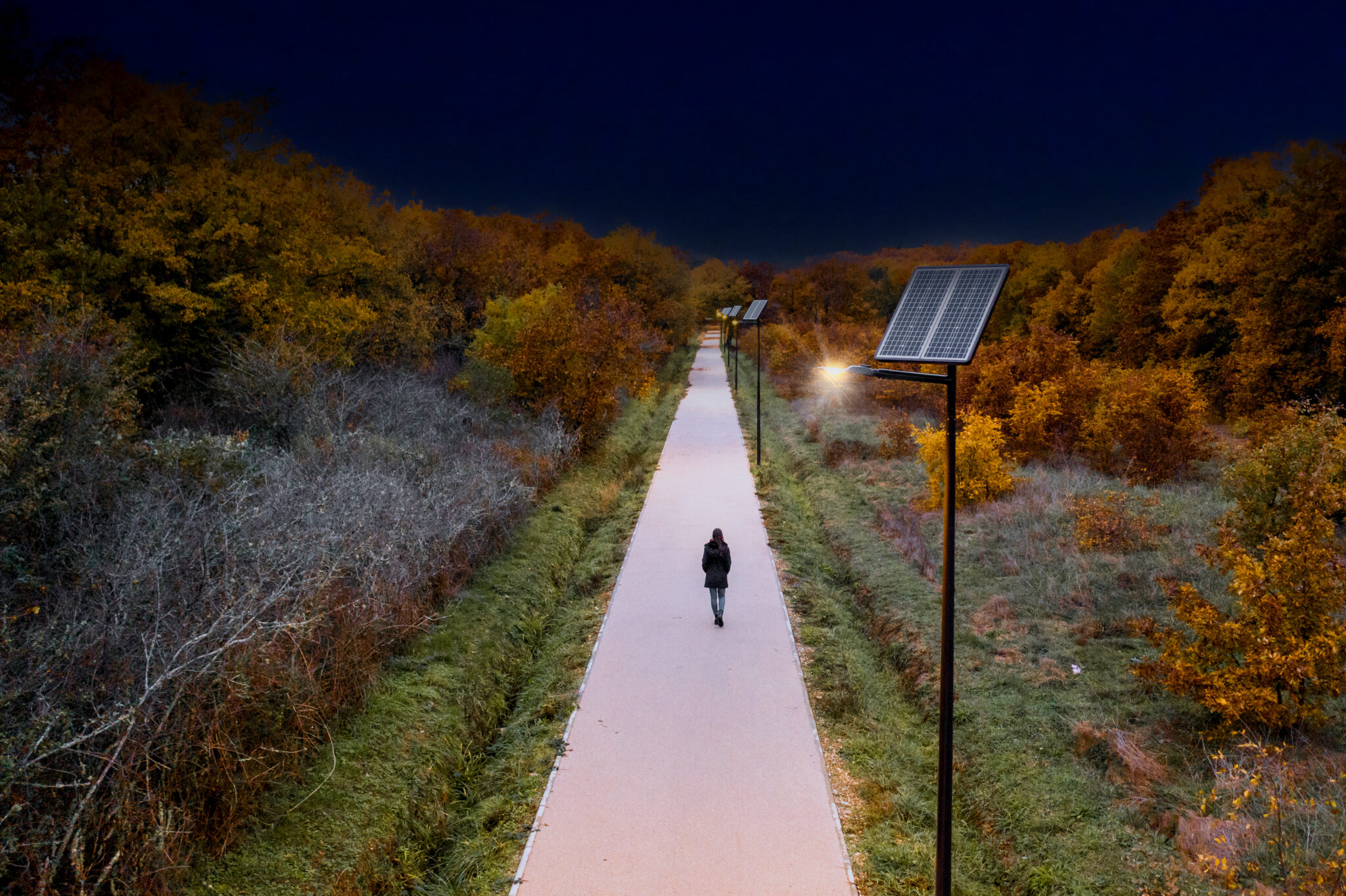
Cycle paths — France & Spain
In these projects, solar lighting supports a concrete use: securing a soft mobility route and improving visibility for journeys by bike or on foot.
In a business area, route continuity is essential. Cyclists, pedestrians and public transport users must be able to move around in good conditions, including outside periods of strong daylight.
Solar lighting provides a response adapted to a localized need, without unnecessarily increasing the weight of the existing infrastructure. This type of project illustrates the possible contribution of solar lighting to SDG 11: making public spaces safer, more accessible and better adapted to everyday uses.
These projects show that lighting infrastructure can have a concrete impact on uses, provided it is designed at the scale of the site, its technical constraints and the needs of the territory.
SDG 11 is part of a broader approach to sustainable development. Solar lighting projects can also contribute to other goals, depending on their context and design.
This cross-cutting approach helps maximize the social, environmental and territorial impact of lighting projects.
SDG 7 – Affordable and clean energy
Solar lighting uses renewable energy to support the energy transition of local territories.
SDG 9 – Industry, innovation and infrastructure
Autonomous solar streetlights are flexible infrastructures, adapted to different contexts and site-specific constraints.

Solar lighting contributes to the energy transition and helps reduce the use of heavy electrical infrastructure.
On the occasion of World Environment Day, SDG 11 highlights an essential challenge: the ecological transition of cities is also built through concrete projects that are visible in residents’ daily lives.
Securing a cycle path, lighting a pedestrian walkway, making a park more accessible or supporting the transformation of a neighbourhood are all actions that can contribute to a more sustainable city.
Faced with these challenges, Sunna Design is committed to designing solar lighting solutions adapted to real uses, site constraints and the objectives of local authorities.
A responsible lighting project is not about adding light everywhere. It is about providing the right light, in the right place, at the right time, with a solution adapted to the territory.
Solar lighting can therefore become a concrete lever to support cities and communities towards safer, more energy-efficient and more resilient public spaces.


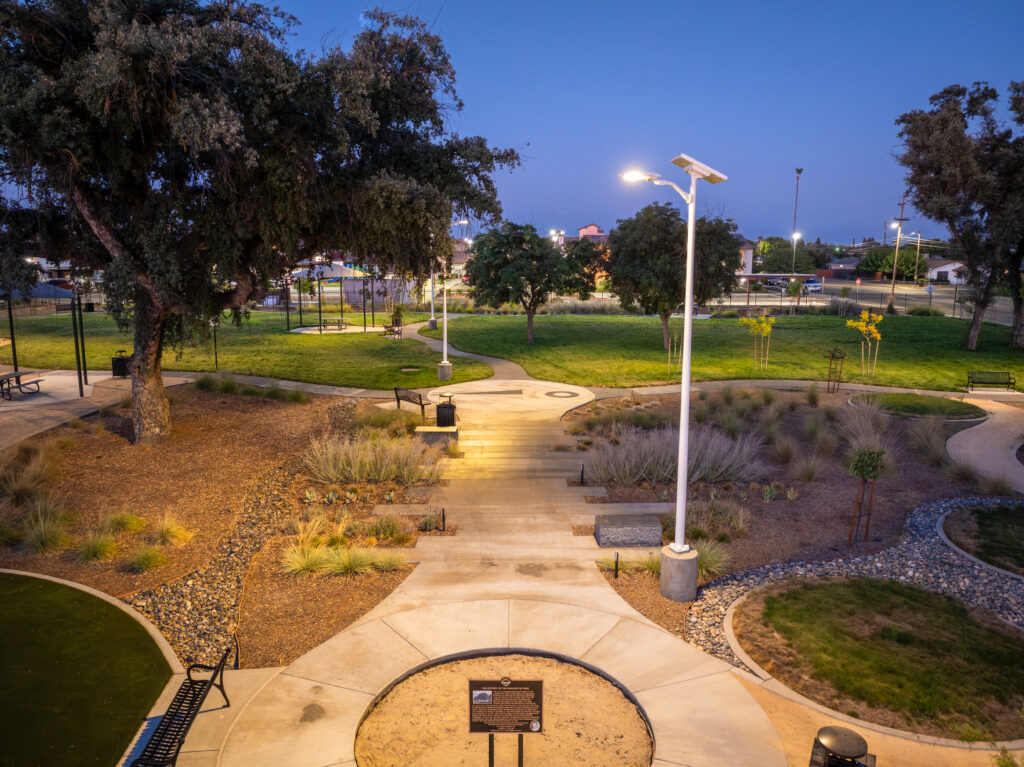
SDG 11 aims to make cities more safe, inclusive, resilient and sustainable. Solar lighting can contribute to this by improving the visibility and accessibility of certain public spaces.
It can be used to light cycle paths, greenways or pedestrian walkways, especially when connecting to the electrical grid is complex or costly.
No. The key challenge is above all to light better: in the right place, at the right time, with an intensity adapted to real-life uses.
A project must take into account the site, the uses, the level of activity, the expected lighting level, the installation constraints and the sunlight conditions.
