About solar lighting May 2026
Heatwaves are reshaping the way public spaces are used: some journeys, walks, and access to services are now happening earlier in the morning, later in the day, or in the evening. In this context, public lighting must support these evolving uses without adding more light. The goal is to provide the right light, in the right place, at the right time, with a focus on sobriety.
Table of contents
Climate change is gradually changing the way we relate to outdoor spaces. During periods of extreme heat, some uses become less comfortable in the middle of the day. People may then adapt their habits: walking earlier in the morning, travelling later in the day, choosing shaded routes or making greater use of cooler spaces.
This evolution affects very different territories: city centres, rural communities, suburban districts, isolated areas, villages, secondary roads or public spaces located far from the grid. Everywhere, places used for passage, soft mobility or relaxation are taking on new importance in everyday life.
A pedestrian path, a cycle lane, a bus stop, access to a public facility or a connection between two neighbourhoods can therefore become more important when uses shift towards less bright hours.
This is where the question of public lighting needs to be considered differently. The aim is not to light more widely, but to better support changing uses.
Parks, green areas, shaded pathways, cycle lanes, traffic-calmed squares or pedestrian routes can play an important role in making everyday movements and uses more bearable during hot periods.
But these spaces are not used in the same way depending on the time of day, the season or the local context. A pathway may be used early in the morning. A cycle lane may be used in the evening. A transport stop may require better visibility at certain times. An isolated access point may need occasional lighting to make movement safer.
Not all these uses justify permanent lighting. Instead, they call for a more precise approach: identifying the areas that are actually used, understanding times of use and adapting light to the real need.
Adapting public lighting to climate change does not mean multiplying light points. A resilient territory is not one that is lit everywhere, all night long. It is a territory capable of prioritising its needs.
Before installing or reinforcing lighting, several questions should be asked:
At what times?
For what uses?
What light level is needed?
Should the lighting be permanent or occasional?
What impact will it have on energy consumption and the immediate environment?
These questions are essential. Overly systematic lighting can lead to unnecessary energy consumption, heavier infrastructure, poorly controlled light spill or lighting in areas that do not need it. The goal is therefore not to add more light, but to place it better.
Good lighting is not necessarily the most powerful. It is lighting that responds precisely to a need: making a pathway easier to read, supporting soft mobility, securing a crossing, guiding users to a transport stop or facilitating access to a facility. This approach helps combine user comfort, energy sobriety and control of environmental impact.
For a long time, public lighting was often designed as a fixed infrastructure: a place, a light point, a regular operating pattern. But the new uses of public spaces invite us to change this logic. The aim is no longer just to light a space. It is to light a use.
This approach means starting from the field: how do people move around? Which routes do they take? At what times? Which spaces need to remain readable? Which places can remain lightly lit? Where is light truly useful?
Identifying priority areas
Not all spaces require the same treatment. Access to a facility, a crossing, a pedestrian path or a cycling connection may require targeted light. Conversely, some breathing spaces, green surroundings or rarely used areas can be protected from excessive lighting.
Adapting light to times of use
Needs are not the same in the early evening, in the middle of the night or early in the morning. Lighting can be designed according to actual times of use: commuting, access to transport, sports activities, soft mobility or occasional uses.
Thinking about sobriety from the design stage
Sobriety is not only about reducing consumption. It also means avoiding unnecessary lighting from the outset. This requires precise positioning, an appropriate light level, controlled operating times and light directed towards the useful area.
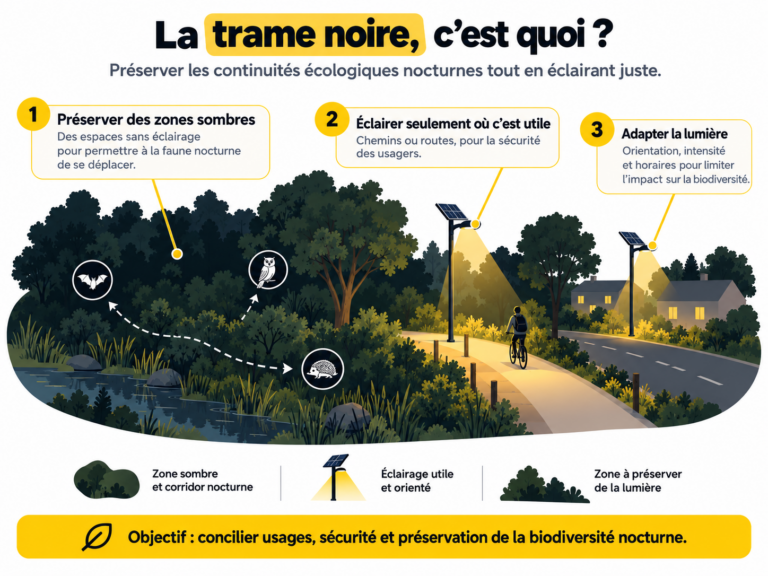
Biodiversity should not be considered separately from climate adaptation. Trees, permeable soils, green areas, parks, hedgerows and ecological corridors help make territories more liveable during periods of extreme heat.
These spaces provide coolness, improve the comfort of living environments, promote water infiltration and contribute to the balance of natural ecosystems. They are useful for people, but they are also living environments. This is why lighting must support human uses without turning these spaces into overexposed areas.
When a pathway crosses a park, runs alongside a green area or serves a soft mobility route, light must be designed with precision. The aim is not to remove all lighting, but to avoid unnecessary lighting that is poorly directed or disproportionate.
The question is therefore not to oppose human uses and the preservation of living ecosystems. It is about finding the right balance: lighting where it is necessary, when it is useful, with the right level of light.
In the face of climate change, public spaces must become more comfortable, more accessible and more resilient. They must allow people to continue moving around, meeting and using everyday infrastructure, even as uses evolve with temperatures.
But this adaptation should not result in an automatic increase in the number of light points. On the contrary, it should encourage another way of designing public lighting: more precise, more sober, more flexible and better integrated into its environment.
For local authorities, this means moving from a logic of systematic lighting to a logic of useful lighting. For territories, it is a way to support new uses while controlling consumption and preserving the spaces that themselves contribute to climate adaptation.
Tomorrow, the quality of public lighting will not be measured only by its power. It will be measured by its ability to meet the right need, in the right place, at the right time. This is the whole challenge of climate-adapted public lighting: not lighting more, but lighting better.
Climate change is changing the way public spaces are used. During periods of extreme heat, some journeys or activities may shift to cooler times of the day, especially early in the morning, late in the day or in the evening. Public lighting must therefore adapt to these new uses without systematically adding more light.
No. The goal is not to add light everywhere, but to identify the spaces that are actually used during less bright hours. Some pathways, access points or transit areas may require targeted lighting, while other spaces can remain dimly lit or unlit.
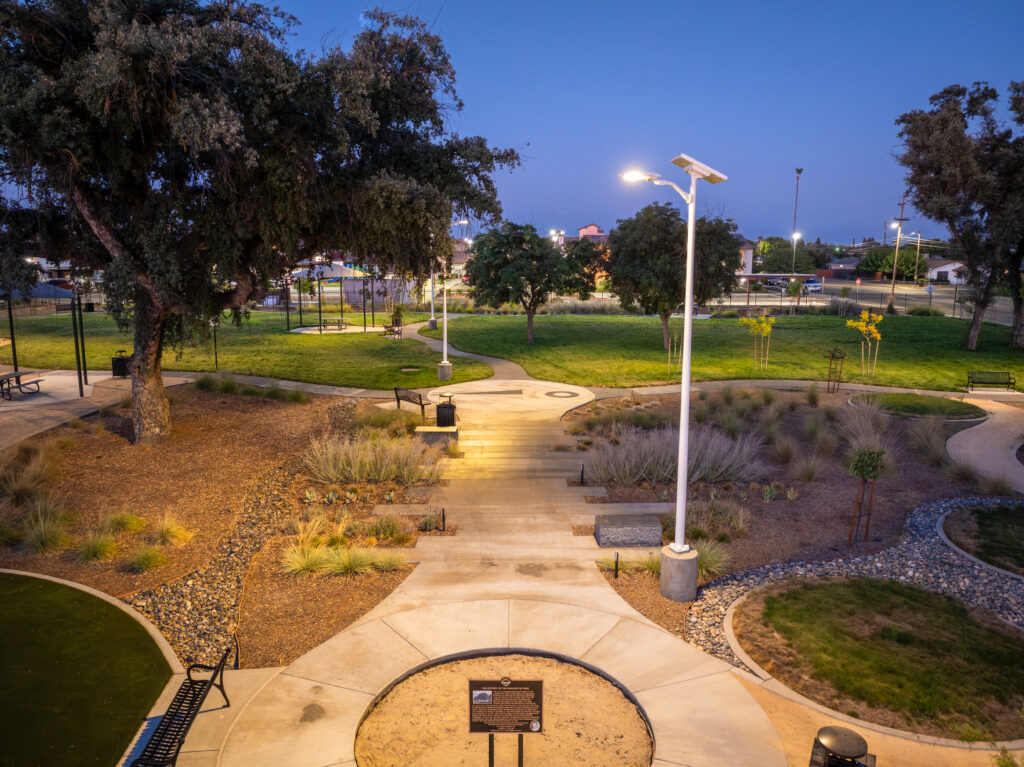
Autonomous solar lighting provides targeted light without systematically extending the electrical grid. It can be useful for pedestrian pathways, isolated access points, cycle lanes, transport stops, secondary roads or public spaces located far from the grid.
We need to start from real uses, light only the areas where it is necessary, adapt operating times and limit unnecessary lighting. This approach supports mobility while controlling energy consumption and preserving green spaces that contribute to climate adaptation.
A site assessment helps define the most suitable configuration according to your objectives and constraints.