About solar lighting April 2026
Light pollution is now a major environmental issue. Organizations such as DarkSky have been raising awareness for several years about the impact of artificial lighting on biodiversity and the quality of the night sky. In Europe, more than 60% of the population can no longer see a natural starry sky, a direct consequence of excessive or poorly managed artificial lighting.
Faced with this challenge, local authorities must address a dual objective: ensuring user safety while reducing the environmental impact of their infrastructure.
However, opposing these two goals is a misconception. The challenge is no longer to choose between lighting or switching off, but rather to learn how to light intelligently, through a design approach tailored to real-world conditions.
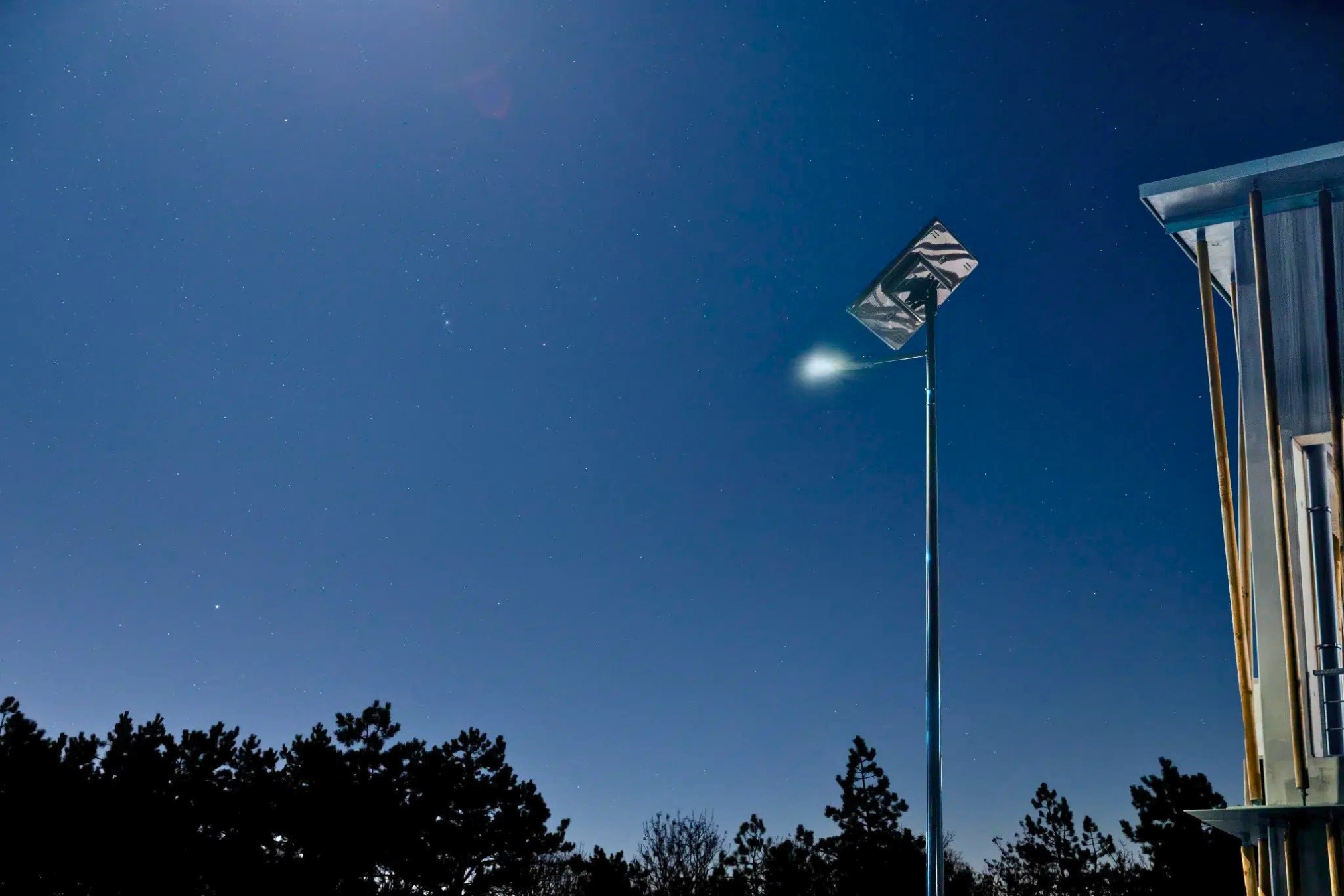
Light pollution is not only determined by the number of lighting points. It often results from poor system sizing or inappropriate usage.
In many areas, lighting remains constant throughout the night, regardless of actual usage. This uniform operation leads to unnecessary over-lighting, particularly in low-traffic areas during off-peak hours.
Effective lighting design should instead rely on a detailed analysis of nighttime usage patterns, in order to adapt lighting levels to real needs.
A significant portion of emitted light is still poorly utilized. When a luminaire spreads light beyond the intended area or upwards into the sky, this energy is wasted and directly contributes to sky glow and light pollution.
Controlling light distribution is therefore essential. Advanced optics now make it possible to precisely direct light onto targeted surfaces while minimizing unwanted emissions.
Color temperature also plays a critical role. Cool white lighting, rich in blue light, has a significant impact on biodiversity and biological rhythms. Conversely, warmer tones such as amber help reduce these effects while maintaining adequate visibility.
Effective lighting is, above all, lighting that adapts to its environment.
Modern technologies allow lighting levels to be adjusted based on:
time schedules
actual usage levels
specific characteristics of each area
Reducing light intensity during off-peak hours, or even partial shutdown in certain contexts, significantly limits light pollution. ADEME identifies these actions as key levers to reduce public lighting energy consumption, with potential savings of up to 50% depending on the configuration.
Contrary to common belief, these adjustments do not compromise safety when properly designed.
The quality of a lighting project depends on its ability to illuminate only where needed.
This involves:
precise optical design
accurate luminaire orientation
reduction of light spill and halos
Well-directed lighting improves visual comfort while reducing light loss. It directly contributes to reducing light pollution in public lighting systems.
Modern systems offer advanced control capabilities:
scheduling
automatic dimming
motion detection
These features enable continuous adjustment of lighting levels based on real-world usage. In this context, solar-powered lighting solutions offer a particularly relevant approach.
Autonomous solar lighting is based on a simple principle: available energy is limited, which requires optimized management.
This constraint becomes an advantage. It encourages more efficient lighting strategies:
adjusted light intensity
optimized usage scenarios
on-demand operation
This shifts lighting from a “constant” approach to a “relevant and adaptive” one.
Some solar luminaires, such as the Elektra fixture, are specifically designed to meet light pollution reduction requirements, with precise light control and fully compliant DarkSky-certified performance.
Without requiring grid connection, solar street lighting enables deployment exactly where needed, without oversizing infrastructure.
It is particularly suitable for:
rural and peri-urban areas
pedestrian pathways and bike lanes
isolated parking areas or sites
sensitive natural environments
In these contexts, solar lighting offers a balanced solution between user safety and preservation of the nighttime environment.
Learn more about light pollution challenges
Explore our resources to better understand these solutions
The idea that “more light equals more safety” is increasingly being challenged.
Poorly designed lighting can cause glare, create shadowed areas and reduce visibility. Conversely, well-designed, uniform and context-adapted lighting significantly improves spatial readability.
Public policies are evolving to better protect nighttime biodiversity.
Concepts such as dark corridors are becoming increasingly important, aiming to preserve ecological continuity without light disturbance.
In this context, lighting projects must integrate from the outset:
energy efficiency objectives
environmental constraints
societal expectations
Local authorities, engineering firms and consultants play a structuring role in this transition.
Regulatory measures, such as the progressive ban on globe luminaires, illustrate this shift toward more sustainable equipment.
Design-phase decisions (technologies, layout, lighting scenarios) directly determine the long-term impact of installations.
Adopting a comprehensive and responsible approach is therefore essential.
Light pollution related to public lighting is not inevitable. It primarily results from technical and design choices that can now be optimized.
By prioritizing lighting that is adapted to usage, precisely directed and intelligently managed, it is possible to reconcile performance, safety and preservation of the night sky.
Autonomous solar lighting solutions fully support this approach, enabling a more sustainable, flexible and context-adapted lighting strategy.
Our experts can support you in designing a solution adapted to your technical, economic and environmental needs.