Lighting a cycle path and a pedestrian promenade without heavy grid connection works, while improving daily user comfort.
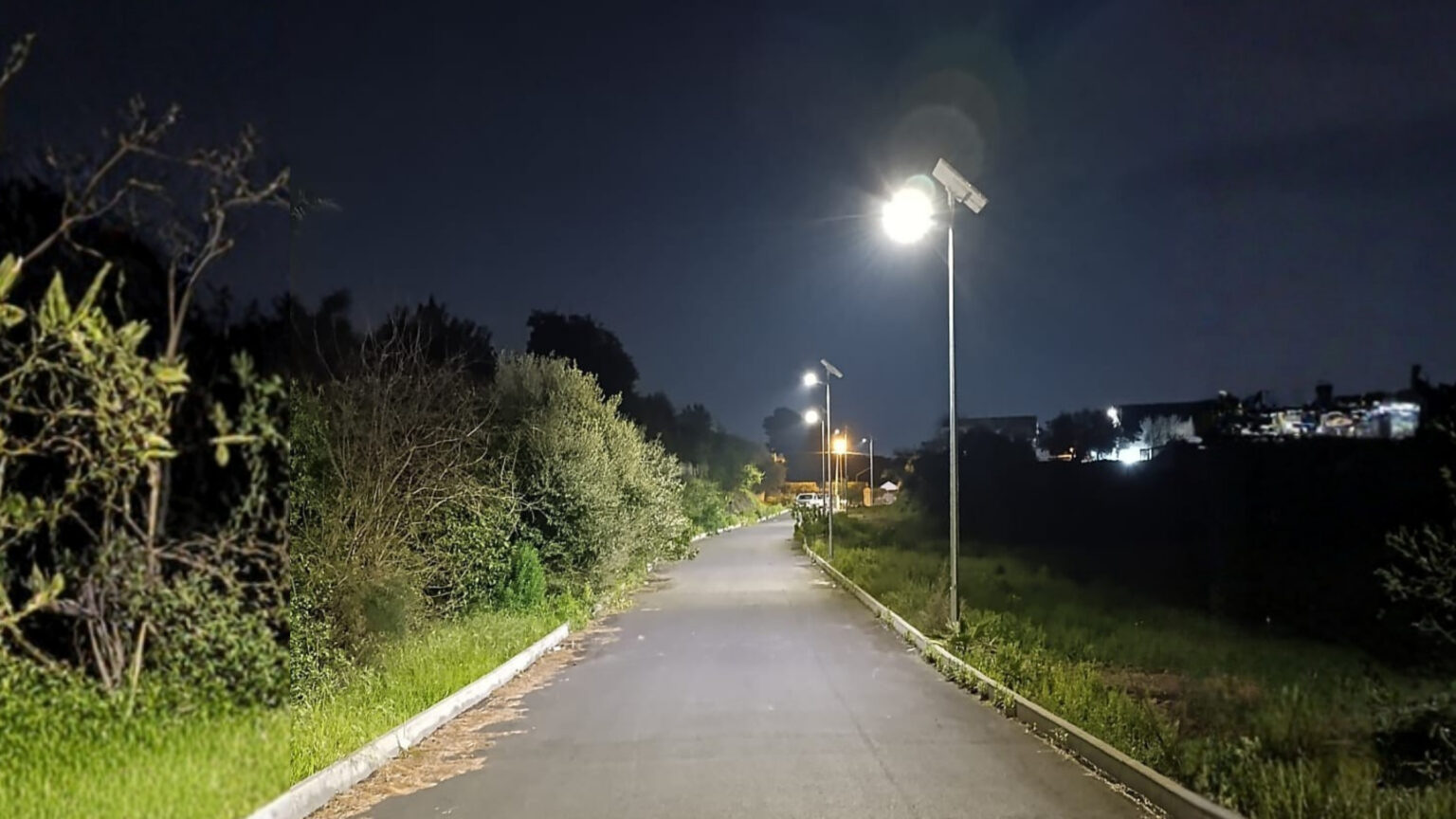
In Gradignan, Gironde, a promenade located in the Bersol business area has been equipped with 24 autonomous solar streetlights to light a pathway used by cyclists, pedestrians, runners, local residents, employees in the area and visitors to nearby shops.
The project supports active mobility through a reliable, intelligent autonomous solar lighting solution, adapted to real on-site usage thanks to presence detection.
Cycle path and pedestrian promenade
Gradignan – Gironde, France
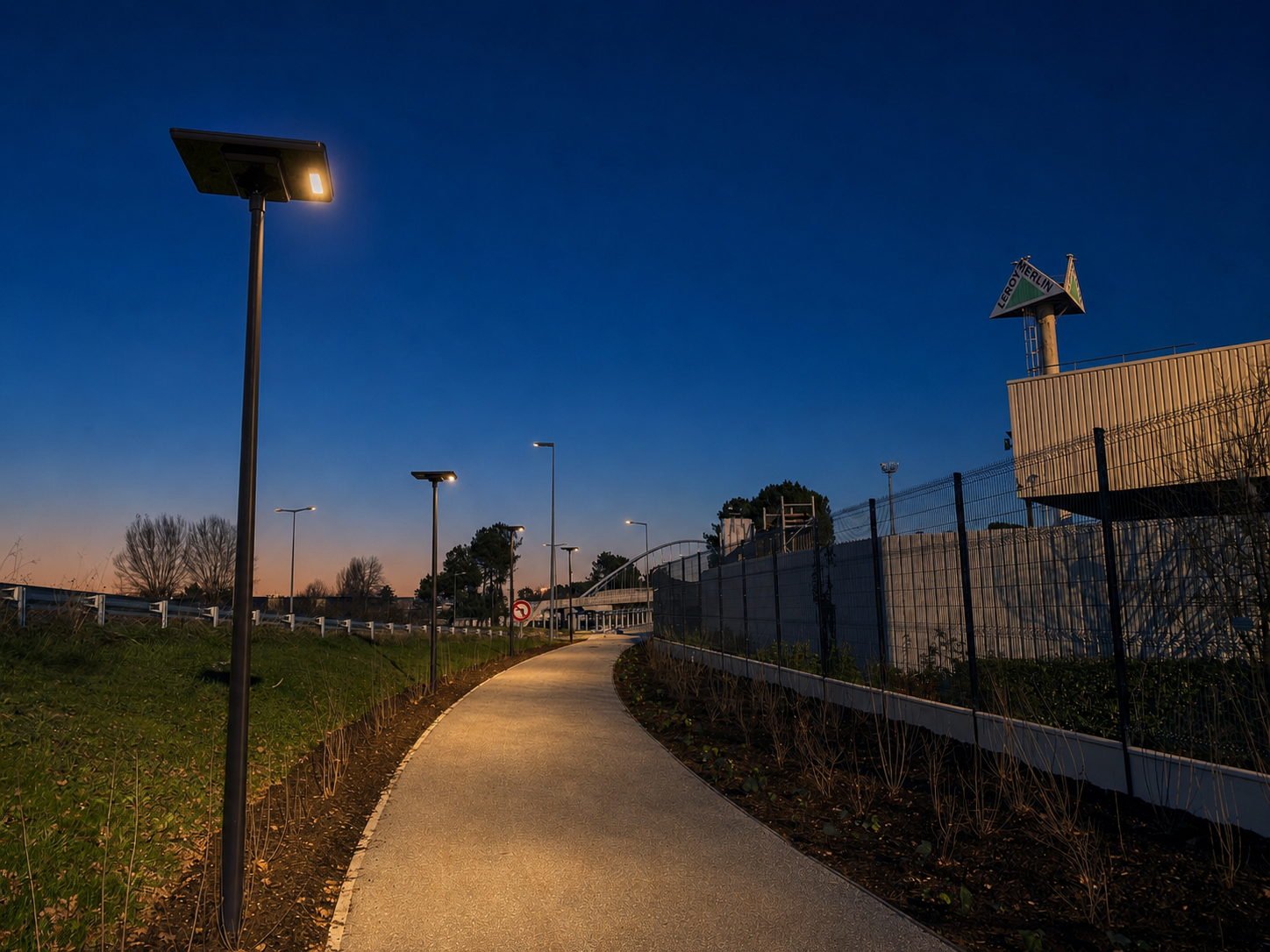
In Gradignan, the promenade runs alongside a business area and supports everyday journeys. It is used by different types of users: cyclists, pedestrians, joggers, employees and visitors heading to nearby shops and surrounding spaces.
This pathway also plays a connecting role. It allows users to reach a bridge crossing over the road, making mobility easier in a busy peri-urban environment. For local residents as well as workers in the area, lighting helps make this route clearer, more comfortable and more reassuring.
This type of development plays an important role in the growth of active mobility. It helps create routes that are clearer, more comfortable and better suited to walking and cycling.
When light levels decrease, lighting becomes essential to improve route visibility, help users better identify the pathway and make journeys more comfortable in the evening, early in the morning or during periods of low light.

Lighting a bicycle path or a pedestrian pathway can quickly become complex when it requires a connection to the electrical grid.
On this type of linear route, the work may involve trenches, cable installation, technical connections and major intervention on the existing site.
The challenge was therefore to provide reliable lighting on an already developed promenade, without making the project heavier or causing long-term disruption to site users. The solution had to meet two objectives: improve user visibility and limit infrastructure work.
In this context, autonomous solar lighting was a particularly suitable solution: each light point can be installed as close as possible to the need, without requiring a major extension of the electrical grid.

To meet the needs of the site, 24 iSSL Maxi Detection 2700K solar streetlights were installed along the promenade, on 4.5-metre poles. These streetlights operate autonomously thanks to their solar panel, battery, LED module and energy management system. The 2700K colour temperature provides a warm light, suited to outdoor spaces and soft mobility areas.
The presence detection feature is a key asset of the project. When a pedestrian, cyclist, runner or worker from the area approaches, the streetlight automatically increases its lighting to improve pathway visibility. When no one is passing by, the light intensity is reduced to preserve the energy stored in the battery and limit unnecessary lighting.
This smart management makes it possible to provide light at the right time, at the right level, according to real usage. On a promenade where footfall varies depending on the time of day, presence detection helps combine user comfort, energy efficiency and system autonomy.

The project was specified in 2019 by the Paris-based lighting design agency Agence ON.
The work was then carried out during the summer by GTM, with subcontractor Cirkad in charge of installing the Sunna Design products.
This collaboration made it possible to deploy a solution adapted to the site constraints and to the real needs of this promenade located in the Bersol business area.
It also illustrates the ability of Sunna Design to integrate into existing development projects, in coordination with lighting design, public works and on-site installation stakeholders.
The installation of the 24 autonomous solar streetlights now makes it possible to light the entire promenade running alongside the road up to a bridge.
The pathway now benefits from better readability for people travelling on foot, by bike or during activities such as running. For cyclists, the lighting improves the perception of the route and its surroundings. For pedestrians and runners, it helps make the route more comfortable, making it easier to reach the bridge used to cross the road.
Thanks to presence detection, the lighting supports users when they pass through the area, without lighting unnecessarily when the promenade is less busy. The project therefore provides a balanced response: greater comfort for users, optimized energy consumption and an installation without heavy electrical grid connection work.
This project illustrates the value of solar lighting for cycle paths and pedestrian pathways, particularly when it comes to lighting an existing route without carrying out major works.

Cycle paths, greenways and pedestrian promenades are essential developments for encouraging more sustainable mobility.
However, lighting these areas can represent a technical challenge, especially when routes are located far from the electrical grid or when interventions on public spaces need to be limited.
Solar public lighting solutions make it possible to install light points as close as possible to the need, without heavy electrical grid connection work, while adapting to the real uses of the site.
For local authorities, business areas and urban planners, this approach helps make pathways more accessible, more comfortable and better suited to everyday mobility.
Our experts support you in designing a solution adapted to your technical, economic and environmental challenges.
Solar Lighting in Africa: 7 Keys to Delivering a Large-Scale Project From Pilot Project to Nationwide Deployment: How Can a Solar Lighting Project in Africa Be Successfully Delivered? What if a solar streetlight could do much more than simply light a road? In Africa, autonomous public lighting is a powerful driver of […]
In Marines, the roundabout connecting the CV-25 and CV-333 roads plays a key role in traffic flow. However, it lacked any form of lighting, compromising nighttime visibility and increasing the risk of accidents. Its distance from the power grid made traditional connection both complex and costly, requiring heavy work and major traffic disruptions. To […]
Lighting a 780-meter bridge without grid connection, while reducing infrastructure costs and environmental impact. Located in the Guanacaste province in Costa Rica, the Puente de la Amistad Bridge is a key road infrastructure connecting the cantons of Cañas and Nicoya. With a length of approximately 780 meters and representing an investment of […]
Italy: Securing a new road from day one with autonomous solar lighting. As part of a new road project in Italy, local authorities sought a solution to make this infrastructure safer, modern, and environmentally friendly from the moment it opened. The goal was to ensure efficient lighting immediately, without relying on a connection […]