Rural & isolated site 28 July 2026
What if a solar streetlight could do much more than simply light a road?
In Africa, autonomous public lighting is a powerful driver of safety, economic development, and social inclusion. From remote villages to major cities, it improves night-time mobility, facilitates access to essential services, and contributes to residents’ quality of life.
However, moving from a pilot project to a nationwide programme requires much more than high-performing technology. It involves gaining a precise understanding of local communities’ needs, adapting equipment to local conditions, and building an organisation capable of deploying, supervising, and maintaining several thousand installations over the long term.
With 50,000 solar streetlights deployed across 4,600 rural communities, the PEP’S Rural programme in Togo demonstrates that a large-scale project relies on a rigorous methodology and a long-term vision. Field studies, logistics planning, training for local teams, structured financing, and 12 years of maintenance were integrated from the programme’s design stage.
Here are the seven essential keys to successfully delivering a large-scale solar lighting project in Africa.
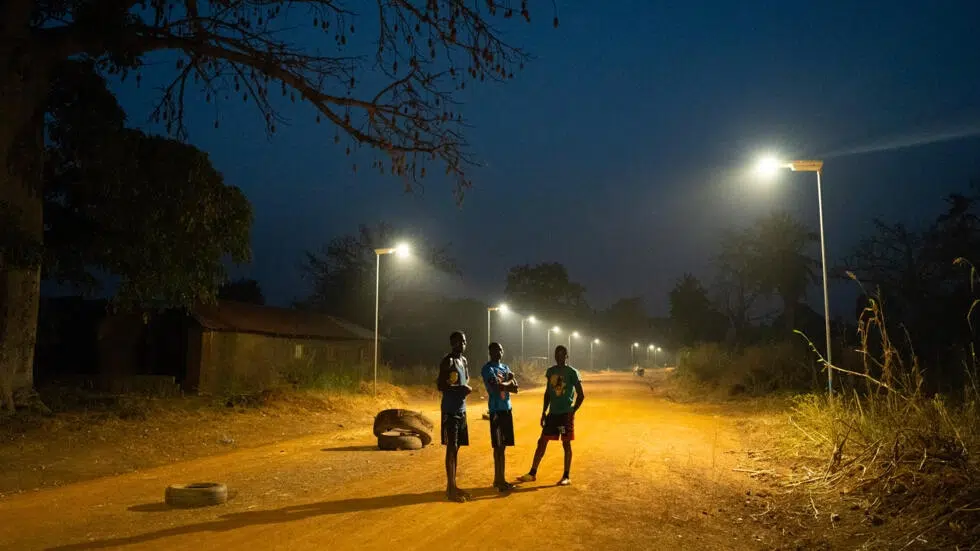
The success of a solar lighting project begins with a clear understanding of the territory’s needs.
Requirements differ depending on whether the project involves lighting rural roads, healthcare centres, schools, markets, public spaces or urban areas. Each installation must therefore address a clearly identified use.
On a rural road, lighting can make night-time travel safer. Near a healthcare centre, it facilitates access to medical care after dark. In a school, market or public space, it helps extend activities into the evening and strengthen local community life.
The objective is therefore not simply to install a light point, but to provide a service that delivers real value to local communities.
This understanding of local uses must be established before the equipment is selected. It may be based on an analysis of existing infrastructure, territorial mapping, demographic data and discussions with local stakeholders.
In Togo, an initial phase of mapping and satellite-based preliminary siting was carried out to identify priority areas. This information was then supplemented by field studies and consultations with prefects, village chiefs and residents. The locations of the installations could therefore be adjusted according to the actual needs of each community.
The impact study conducted as part of the PEP’S Rural programme shows that access to lighting has encouraged night-time travel, the use of public infrastructure and community activities. Overall, 91% of the residents surveyed reported an improvement in their quality of life.
Every site has its own environmental constraints. Before selecting the equipment, it is essential to assess the exact conditions in which it will be installed.
This assessment should notably take into account:
The level of available solar irradiation and its variations throughout the year directly influence the amount of energy that can be produced. High temperatures, dust and humidity can also affect the performance and service life of the components.
In coastal areas, corrosion requires particular attention. In other regions, heavy rainfall, strong winds or sandstorms may represent the main constraints.
A solution designed for one region cannot therefore be automatically replicated in another without a preliminary assessment. Solar irradiation levels, the rainy season, wind exposure and site accessibility must all be incorporated into the project specifications.
An accurate site assessment makes it possible to adapt the solution to actual field conditions and ensure its long-term operation. It also helps anticipate installation, transport and maintenance constraints that could delay deployment once the project is underway, particularly in rural areas and remote sites.
An undersized system may fail to provide the required lighting level or autonomy. Conversely, an oversized system may generate unnecessary costs.
The sizing process must therefore take into account:
The light output must be adapted to the intended use of the site. A road, market or healthcare centre will not necessarily require the same lighting level.
Lighting profiles make it possible to adjust the power output throughout the night. For example, the intensity can be reduced during periods of low activity and then increased when a presence is detected.
The energy storage capacity must enable the streetlight to operate for the entire required period, including during periods of low solar irradiation.
Sizing does not therefore consist of selecting a standard power rating for an entire territory. It must combine the photometric requirements, operating profile, available solar resources and climatic conditions of each area.
The objective is to achieve the best balance between performance, autonomy, cost and service life.
In Togo, the classification of needs took population density and existing infrastructure into account in order to distribute the equipment consistently across the different communities. This method made it possible to adapt the installations to actual uses rather than applying a uniform model throughout the country.
Solar lighting projects may be exposed to particularly demanding conditions, including extreme heat, dust, humidity, heavy rainfall, strong winds and corrosion.
In these environments, equipment reliability directly determines the continuity and quality of the service provided to local communities.
The main criteria to consider include:
The solar lighting solutions must be capable of withstanding the site’s climatic conditions over the long term. Their design must protect sensitive components against impacts, harsh weather conditions and high temperatures.
Thermal management is particularly important for preserving the performance of batteries, LEDs and electronic components. Excessive heat can accelerate their ageing and reduce their service life.
The mechanical resistance of the equipment and the quality of its protection against water, dust and corrosion must also be assessed according to the installation site. These criteria are particularly important when streetlights are installed in remote areas, where every intervention may require significant logistical resources.
Equipment selection should therefore not be based solely on its purchase price. The reliability and long service life of the equipment are essential to maintaining service quality and limiting interventions over time. The relevant cost is not simply the cost of the equipment when purchased, but its total cost over the entire operating life of the project.

One of the main advantages of autonomous solar lighting is its ease of installation.
Unlike a conventional lighting network, it generally requires neither a connection to the power grid nor trenching. The absence of underground cabling and extensive civil engineering work makes it possible to accelerate deployment, particularly in remote areas.
However, this speed of installation must be supported by appropriate logistics planning. Transport, storage, equipment preparation and the organisation of the different stages of the project must all be anticipated.
When several thousand streetlights are involved, logistics become a central component of the project. They must ensure a continuous supply of equipment to installation sites while preventing shortages, delays and preparation errors.
The preparation of local teams is also essential. Clear installation procedures and appropriate training help reduce errors, improve installation quality and accelerate deployment.
The standardisation of equipment and installation methods also makes the teams’ work easier. It ensures a consistent level of execution across a large number of sites while simplifying training and installation quality control.
The PEP’S Rural programme illustrates this ability to install a large number of systems across an extensive territory. To achieve this, a dedicated team of ten people was established in Lomé, working in coordination with approximately 80 regularly trained local operators. At the same time, up to 500 units were shipped to Togo every week to ensure a continuous supply to the installation sites. This organisation made it possible to deploy 50,000 solar streetlights across nearly 4,600 rural communities while maintaining consistent installation standards.
The success of a project is not measured solely by the number of streetlights installed. It also depends on their ability to operate reliably over the long term.
Maintenance must therefore be planned from the project design stage. This preparation notably involves:
Training enables local technicians to carry out the necessary inspections and maintenance operations. The availability of spare parts reduces service restoration times whenever a component needs to be replaced.
Equipment supervision makes it easier to monitor the operation of the installations and identify potential anomalies.
Finally, preventive maintenance makes it possible to inspect the condition of the equipment regularly and intervene before a fault results in a service interruption.
Responsibilities, response times and reporting procedures must be defined from the launch of the programme. Without this organisation, even high-performing equipment may gradually lose efficiency due to a lack of regular monitoring.
In Togo, the programme is supported by a 12-year maintenance contract covering preventive operations, corrective interventions and digital monitoring tools.
An annual preventive maintenance operation notably makes it possible to clean the equipment, check its stability, analyse its operating data and carry out any necessary updates. When an issue is reported, teams can intervene within a planned period of 14 days using a dedicated platform and geolocated digital tools.
This organisation helps ensure the long-term sustainability of the installations and maintain the level of service expected by local communities over time.
Moving from a pilot project to a regional or nationwide programme requires an organisation capable of delivering the same installation quality across a large number of sites.
Scaling up relies on:
Standardising equipment and methods simplifies preparation, installation and maintenance. It also facilitates team training and spare-parts management.
Fleet management makes it possible to monitor all installed equipment and maintain an overall view of its operation.
Performance monitoring is essential to confirm that the streetlights are delivering the expected level of service and to identify potential faults quickly.
Finally, controlling the total cost of ownership makes it possible to evaluate the project throughout its entire service life. This includes not only the purchase of the equipment, but also its installation, maintenance and operating life.
For a nationwide programme, financing must also be anticipated. The selected structure must cover not only the purchase and installation of the equipment, but also its supervision, maintenance and the support provided to local teams over several years.
For the PEP’S Rural programme, Sunna Design developed a tailor-made financing solution supported by a French Treasury loan and structured in partnership with BPI-AE. Financing was therefore integrated into a comprehensive approach combining technology, deployment and long-term maintenance.
The example of Togo demonstrates that a well-structured project can be deployed on a large scale while delivering tangible benefits to the daily lives of local communities.
Experience from major solar lighting programmes shows that an autonomous solar streetlight can do much more than simply light a road.
It can make travel safer, facilitate access to essential services, extend economic activities and make public spaces more attractive. However, these benefits are sustainable only when the technology forms part of a comprehensive approach built around local conditions.
In Togo, 25% of students now study in the evening, compared with only 1% before the streetlights were installed. Night-time visits to healthcare centres and water points have also increased by 30%.
Furthermore, 23% of residents now report travelling frequently at night to participate in social or religious activities, compared with 8% before the deployment. More than two out of three residents also report being satisfied with public lighting, compared with only 9% previously.
These results show that by combining a clear understanding of local uses, field assessments, accurate system sizing, suitable equipment, simplified deployment, sustainable maintenance and large-scale organisation, solar lighting can become a powerful driver of territorial development.
Togo’s experience also demonstrates that the success of such a programme depends on the coordination of numerous areas of expertise: engineering, financing, mapping, production, logistics, training, supervision and maintenance.
This methodology can be replicated in other African countries, provided that each project is adapted to the needs of local communities and actual field conditions.
This approach also supports United Nations Sustainable Development Goal 7, which promotes access to affordable, reliable, sustainable and modern energy for all.
The objective is therefore not to reproduce an identical solution everywhere, but to deploy a proven methodology capable of adapting to each territory while maintaining the same standards of quality, reliability and service performance.
It makes it possible to equip remote areas quickly, without a grid connection or extensive civil engineering work. Each installation operates autonomously using solar energy.
The intended uses, solar irradiation, climatic conditions, site accessibility and lighting requirements must all be assessed. This information helps determine the appropriate system sizing and streetlight positioning.
Reliability depends on accurate system sizing, robust equipment and maintenance planning from the outset. Training local teams and supervising the installed fleet also make long-term monitoring easier.