About solar lighting 1 October 2026
On the occasion of European Sustainable Development Week, let’s take a closer look at an issue that is becoming increasingly important in urban and regional planning policies: preserving the night.
Reducing the energy consumption of public lighting is essential. But the ecological transition now raises a broader question: where, when and how do we really need light?
This is exactly what the dark ecological network is all about.

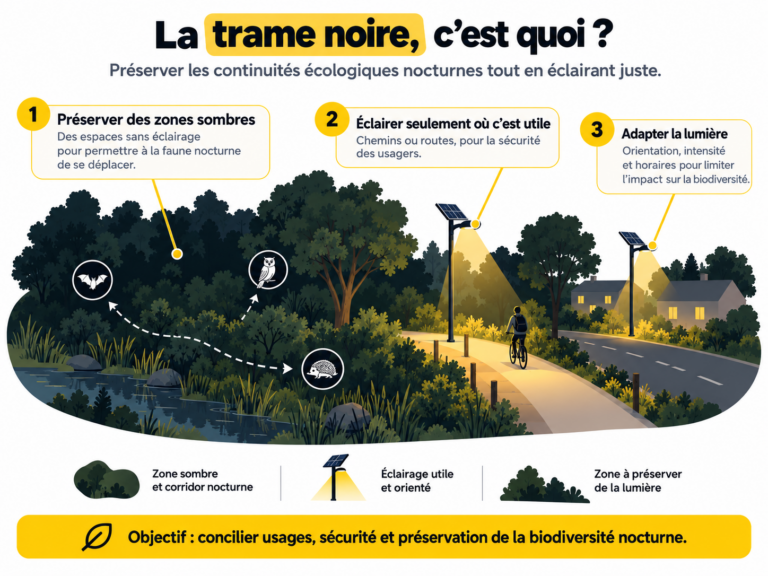
Following green and blue ecological networks, which aim to preserve terrestrial and aquatic ecological continuity, dark ecological networks focus on nocturnal ecological continuity.
For many species, darkness is essential for moving, feeding, reproducing and resting. The French Biodiversity Agency points out that artificial lighting at night can lead to habitat loss, increase habitat fragmentation and, in some cases, cause direct mortality. Dark ecological networks therefore aim to preserve or restore corridors of darkness that allow nocturnal wildlife to move freely.
The objective is not to systematically switch off public lighting, but to find the right balance between users’ needs and the preservation of darkness. This issue is becoming increasingly tangible for local authorities: on September 8, 2026, Cerema published a study carried out in the Pays Castelroussin Val de l’Indre area, combining light pollution data with ecological connectivity and field measurements to identify potential improvements.
The issue therefore goes beyond simply choosing an efficient streetlight: it is about considering lighting at the scale of the entire territory. This is what distinguishes dark ecological networks from an approach focused solely on light pollution: they also consider the continuity between dark areas and their ability to remain connected for nocturnal wildlife.
In an area with biodiversity considerations, the first question should be simple:
Does this area really need to be lit?
When lighting is necessary, whether on a pathway, cycle path, street or parking lot, the next step is to consider four parameters: where the light is directed, at what intensity, with which spectrum and for how long.
The first step is to illuminate only the area that actually needs light. The position of the lighting point, its height, orientation and photometric distribution should concentrate the light on the area being used, without unnecessarily illuminating vegetation, building façades or the night sky. This level of precision is particularly important in parks, greenways and natural areas.
The equipment can then be selected according to these needs, rather than the other way around. Depending on the site, suitable photometric distributions, shields or designs that limit upward light emissions can help better control the light. At Sunna Design, the Elektra luminaire illustrates this approach with several photometric distributions, an optional shield and Dark Sky certification.
The objective is therefore not only to use less light, but above all to use light more precisely.
The amount of light is not the only parameter to consider. Its color temperature and, more broadly, its spectrum can also affect species and environments differently. In sensitive areas, warmer color temperatures and a reduced proportion of blue light can be among the criteria considered from the project design stage.
Warmer color temperatures, or even amber spectra, may be preferred when appropriate for the local context. For example, some Sunna Design solutions are available down to 2,200 K, while Elektra is also available in an amber version containing less than 2% blue wavelengths. These characteristics should always be considered in relation to the species present, the site’s uses and the project’s requirements.
Lighting can also change throughout the night.
An area used at 8 p.m. does not necessarily require the same lighting level at 2 a.m. Dimming, switching lights off during certain periods or using motion detection can adapt lighting to actual patterns of use rather than maintaining a constant level throughout the night.
These dimming scenarios can be programmed into lighting profiles and adjusted via the SunnAPP. The value does not lie in the technology itself, but in the ability to adapt lighting levels over time to the actual needs of the site.
Motion detection can complement this approach: lighting remains at a reduced level when no users are present and increases temporarily when needed. This makes it possible to combine user comfort with a reduction in unnecessary lighting.
The principle is simple: more light when it is needed, less when it is not.
A solar streetlight is not automatically beneficial to biodiversity. If it is too powerful, poorly oriented or unnecessarily switched on throughout the night, it can also contribute to light pollution.
Its value therefore lies in combining energy autonomy with precise control of lighting.
Energy autonomy also offers another advantage: there is no need to extend the electrical grid to the lighting point. Depending on the project, this can reduce the need for cables, trenching and certain grid connection works, which is particularly valuable in natural areas, parks, greenways and areas with limited infrastructure.
In these environments, reducing construction work does not replace an ecological assessment of the site, but it can help limit certain interventions affecting the ground and vegetation.
In Cambes, in the Gironde region of France, UP2 solar streetlights were installed along a street that previously had no public lighting network. As no grid connection or civil engineering work was required, the trees surrounding the installation area did not need to be disturbed. This is a practical example of how solar autonomy can address an infrastructure constraint while limiting construction work.
Dark ecological networks remind us that there is no one-size-fits-all solution. Above all, they encourage us not to consider each lighting point in isolation: even a well-designed lighting system can contribute to the fragmentation of a nocturnal ecological corridor if it is poorly positioned or remains switched on at the wrong time.
Before selecting equipment, it is important to understand the site: how is the area used at night? Which spaces genuinely need to be illuminated? At what times? Is the area located near an ecological corridor, a vegetated area or a sensitive habitat? How will the future lighting point fit into the territory’s network of dark areas? What lighting level is actually necessary?
The assessment of the site and its environment should therefore guide the project. The choice of solution comes afterwards: photometric distribution, lighting level, color temperature, programming and motion detection are tools used to meet an identified need, rather than ends in themselves.
Preserving the night does not mean giving up on lighting. It means making better decisions about where, when and how light should be provided.
This approach is also part of Sunna Design’s broader CSR approach: combining solar autonomy with efforts to promote energy efficiency, equipment durability and better integration into local environments. Solar lighting can therefore become a genuine tool for creating lighting that is more efficient, more precise and better adapted to its surroundings.
Because the best light is not always the one that shines the brightest, but the one that shines where and when it is needed.
A dark ecological network is a network of areas and nocturnal ecological corridors where darkness is preserved in order to limit the effects of artificial light on biodiversity. It complements green and blue ecological networks by taking into account the movements and needs of species that are active at night.
Public lighting can fragment nocturnal ecological corridors when it is too intense, poorly directed or kept on unnecessarily throughout the night. Integrating a dark ecological network into a lighting project therefore means considering where light is genuinely needed, at what time and at what lighting level.
Several measures can be combined: limiting lighting to useful areas, directing the light precisely, choosing an appropriate color temperature, reducing intensity during periods of low activity, and using lighting schedules or motion detection where relevant. The aim is to provide the right amount of light, in the right place and at the right time.