About solar lighting 3 November 2026
How do you plan a successful solar street lighting project? Whether you are lighting a road, car park, cycle path or remote site, choosing a solar streetlight involves much more than comparing wattages and prices.
A successful installation depends on several factors: lighting needs, climatic conditions, energy autonomy, equipment durability, local regulations and operating costs.
Solar street lighting specifications should define the expected performance, site constraints and technical evidence required from manufacturers. They make it possible to compare solutions objectively and select equipment that meets the project’s actual needs.
Which technical criteria should you include? Which standards apply in France and internationally? How can you verify the reliability of a manufacturer’s performance claims?
Discover the 10 essential criteria for planning a reliable, high-performance and long-lasting solar street lighting project.
Contents

Unlike conventional street lighting connected to the electricity grid, an autonomous solar streetlight generates, stores and uses its own energy.
Its operation relies on four complementary components: a photovoltaic panel, a battery, an LED luminaire and an electronic energy management system.
These components must be sized together. Optimising solar autonomy requires the right balance between photovoltaic panels, battery capacity and the lighting profile. Likewise, achieving uniform light distribution across a road requires suitable photometric design, not merely a high stated luminous flux.
The specifications must therefore assess the overall performance of the system, rather than considering each component in isolation.
Before consulting manufacturers, several key details should be established:
This information provides the foundation for site-specific sizing, whether the project involves a French municipality, an urban development elsewhere in Europe or a large-scale lighting programme in Africa.
How many lumens are needed to light a road or car park? The answer depends on the site’s layout, how it is used and the required performance levels.
Three measurements should be distinguished:
Lighting uniformity, glare and light distribution are equally important.
A narrow street, a public square and a car park do not require the same optics. Pole positions, heights and spacing directly influence lighting performance.
The EN 13201 series of standards, together with the international CIE 115 recommendations, provide guidance for selecting lighting classes suited to different applications.
Include in the specifications: a photometric study stating the required lighting levels, uniformity, layout assumptions and IES or LDT photometric files.
Energy sizing is one of the most important aspects of autonomous solar street lighting.
Average annual sunshine alone cannot establish how a solar streetlight will perform throughout the year. The system must also account for periods of low photovoltaic production.
Performance depends on location, seasonal variations, night length, temperature and weather conditions.
Sizing must therefore consider the luminaire’s night-time energy demand, available solar generation, energy storage capacity and system losses.
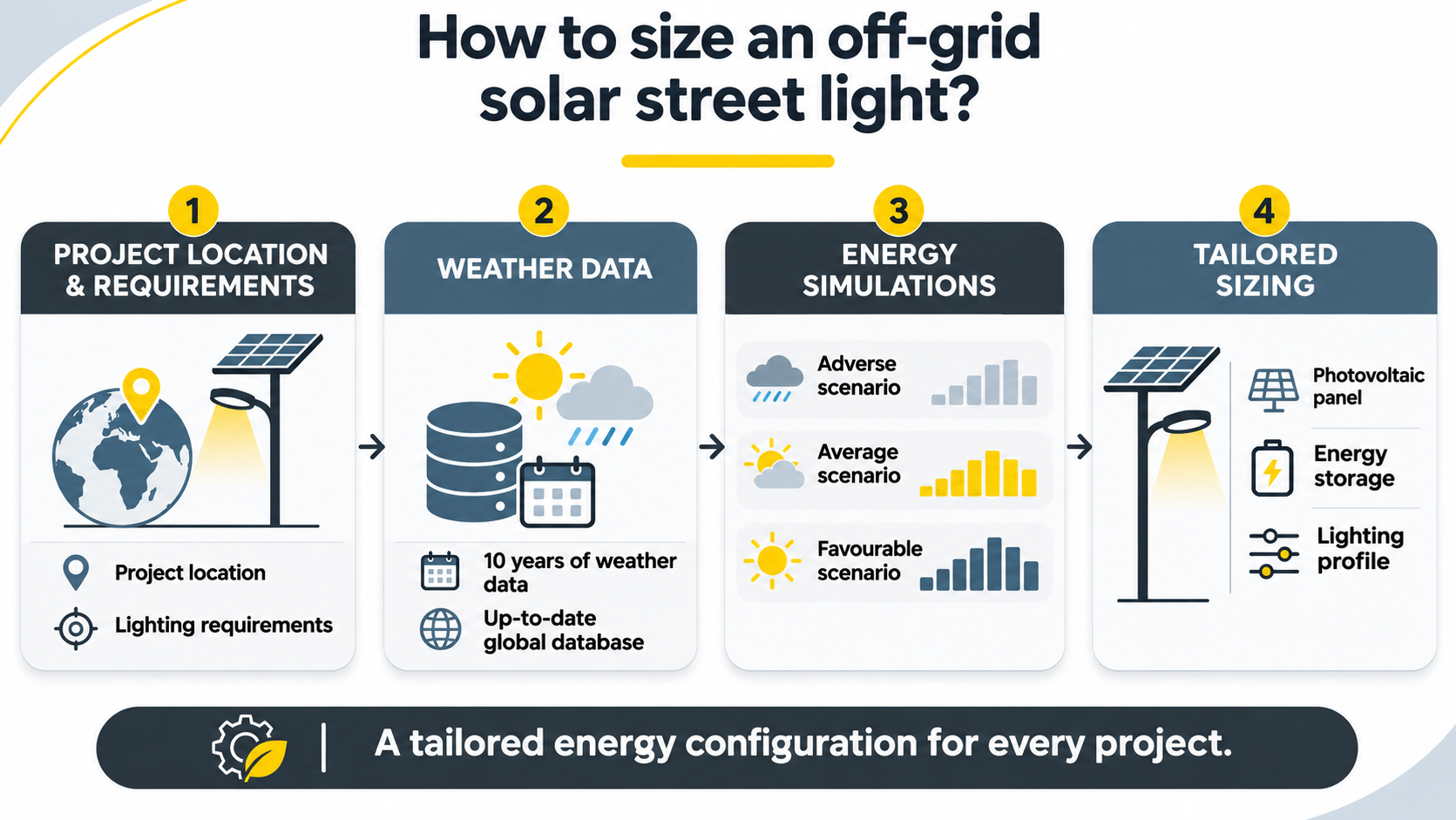
At Sunna Design, engineers use specialist simulation software based on ten years of historical weather data, regularly updated and covering numerous regions worldwide.
Depending on the project’s location, different scenarios can be analysed, from average conditions to the least favourable periods.
This analysis helps tailor the photovoltaic configuration, energy storage and lighting profiles to the site’s actual constraints, aiming for the best balance between performance, autonomy and cost.
Find out more about Sunna Design’s solar lighting studies and sizing services.
Include in the specifications: a site-specific energy study detailing the climatic data used, calculation assumptions, scenarios analysed and selected lighting profile.
The power rating of a solar panel is expressed in watt-peak (Wp). It represents a rated output measured under standard test conditions, not the amount of energy actually produced each day.
Real-world production varies with solar irradiation, orientation, tilt, shading and panel temperature.
For example, horizontal panels can be suitable in certain intertropical regions, while an appropriate tilt can improve solar energy collection in temperate climates.
The international standards IEC 61215 and IEC 61730 provide references for photovoltaic module qualification and safety. Compliance with these standards does not guarantee identical service life in every environment.
Different system architectures can address these needs, from panels integrated into all-in-one luminaires to separate, adjustable solar generators.
Explore Sunna Design’s solar street lighting product ranges.
Include in the specifications: photovoltaic power, panel technical characteristics, relevant certifications and solar production assumptions.
The battery stores the energy generated during the day to supply lighting at night.
Its capacity, expressed in watt-hours (Wh), is an important indicator, but it does not determine actual autonomy on its own.
The specifications should also consider storage technology, operating temperatures, charge and discharge cycles, and component ageing.
Two technologies used in professional solar street lighting include:
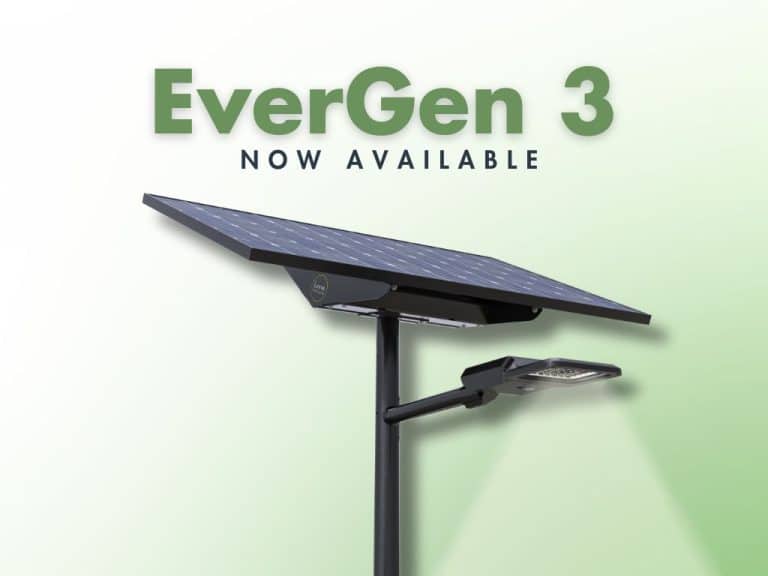
At Sunna Design, the iSSL and UP ranges use NiMH batteries, while EverGen 3 incorporates LiFePO4 batteries.
Operating temperature ranges, stated service lives and warranty terms vary by product.
It is therefore essential to distinguish between estimated service life, expected performance and the commercial warranty. A battery designed to last more than ten years will not necessarily retain the same performance under every operating condition.
Include in the specifications: battery technology, usable capacity, temperature range, safety evidence, warranty conditions and replacement arrangements.
Effective street lighting should deliver the right amount of light, precisely when it is needed.
Depending on how the site is used, it may be appropriate to schedule dimming during low-traffic periods or add presence detection.
This approach helps manage energy consumption without unnecessarily oversizing the installation.
Available functions may include time scheduling, dimming, motion detection and equipment monitoring.
The embedded electronic intelligence SunnaCore, developed by Sunna Design, helps manage available energy and adapt light output according to programmed profiles.
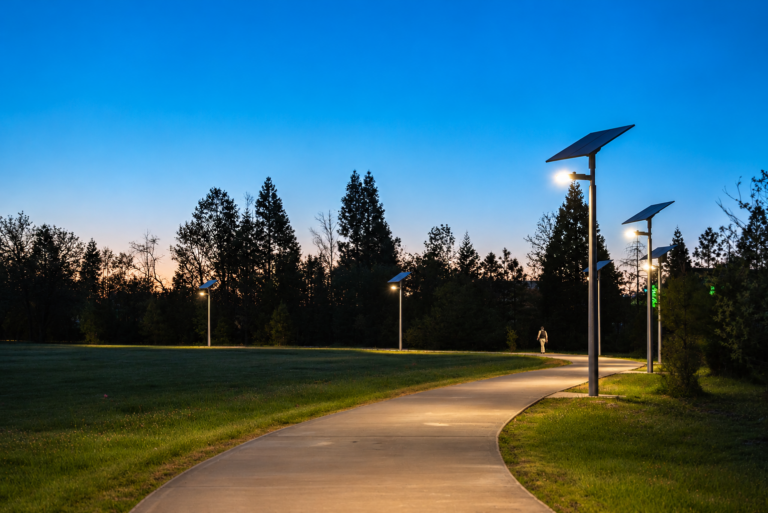
In Gradignan, near Bordeaux, France, 24 autonomous solar streetlights with presence detection were installed to illuminate a cycle path and pedestrian walkway.
Such operating modes must nevertheless be designed around actual use, photometric objectives and the project’s regulatory requirements.
Include in the specifications: available lighting profiles, detection options, monitoring functions and system behaviour when available energy decreases.
Solar streetlights are continuously exposed to outdoor conditions: rain, dust, wind, humidity, corrosion, impact and temperature fluctuations.
Their resistance should be assessed using verifiable technical characteristics and appropriate tests.
Two protection ratings are particularly important:
These ratings should be checked for the relevant components: luminaire, electronics, battery or system enclosure.
Wind resistance, vibration and corrosion also require particular attention.
In coastal areas, airborne salt can accelerate the deterioration of certain materials and coatings. The ISO 9223 standard classifies atmospheric corrosivity, whileISO 9227 specifies salt spray test methods.
At Sunna Design, products and components undergo various resistance tests according to their configurations. For example, the Elektra luminaire carries IP66 and IK10 ratings and has undergone 1,500 hours of salt spray testing in accordance with ISO 9227.
These results must be interpreted in relation to the tested component and test protocol: a corrosion test does not, on its own, guarantee service life in a marine environment.
Include in the specifications: required IP/IK ratings, relevant test evidence, anticorrosion treatments and site-specific structural calculations.
The purpose of street lighting is not to produce the maximum amount of light, but to deliver lighting appropriate to the area and its actual uses.
Poorly directed lighting can produce unwanted light spill towards homes, the night sky or natural habitats.
The specifications should therefore cover light distribution, shielding devices, operating hours and colour temperature.
Warm-white solutions, such as 2,200 K or 2,700 K, and amber lighting may be preferred in sensitive environments. However, impacts on biodiversity also depend on the light spectrum, intensity, duration and direction.
In France, the ministerial order of 27 December 2018 on light pollution sets limits on colour temperature and upward light emissions for installations within its scope.
Some protected natural areas are subject to stricter requirements.
Include in the specifications: available colour temperatures, photometric distribution, light control devices and night-time scheduling options.
Autonomous solar streetlights can be installed without connection to the electricity grid, eliminating the need for trenches to lay power supply cables.
This is particularly valuable for remote sites, already-developed areas and locations where grid connection work would be complex or costly.
Solar lighting can greatly simplify installation by removing the electrical grid connection, while still requiring foundations suited to the project.
Depending on site conditions, ground investigations and permits may also be required.
Pole selection must account for height, equipment weight, wind-exposed area and the resulting structural loads.
Site access, positioning and future maintenance requirements must also be anticipated.
Include in the specifications: installation drawings, foundation recommendations, pole specifications, required structural calculations and installation instructions.
Although autonomous solar lighting avoids certain grid-related interventions, it does not eliminate every maintenance requirement.
Depending on the site, periodic checks may cover photovoltaic panels, fixings, electronics, batteries and the luminaire’s overall condition.
Dust, salt deposits and highly polluted environments may also make appropriate cleaning necessary.
The specifications should set out component accessibility, spare part availability and responsibility for maintenance work.
Warranty terms should be reviewed carefully, including duration, covered components, exclusions, replacement procedures and service conditions.
Include in the specifications: a preventive maintenance plan, technical documentation, warranty terms and support arrangements.
The unit price of a solar streetlight is not enough to assess a project’s economic value.
All costs should be considered over the same period, such as 10 or 15 years, using a total cost of ownership (TCO) analysis.
The comparison should include equipment supply, transport, poles and foundations, installation work, energy consumption, maintenance and any component replacements.
For a grid-connected installation, grid connection, cabling and electricity costs must also be considered.
Solar lighting offers significant economic advantages, particularly by avoiding grid connection work and electricity purchased from the grid. A total-cost analysis helps quantify these savings according to the project’s characteristics.
This is illustrated by the Santa Fe County solar street lighting project in the United States, where an autonomous solution was selected instead of the costly grid connection originally envisaged.
Include in the specifications: an itemised proposal covering installation, operation and maintenance costs, together with replacement assumptions for the chosen period.
The requirements applying to solar street lighting depend on the country, type of installation, surrounding environment and the contracting authority’s specifications.
It is essential to distinguish between technical standards, mandatory regulations and project-specific contractual requirements.
Several standards can provide a useful basis for drafting specifications:
| Standard or reference | Main scope |
|---|---|
| EN 13201 and CIE 115 | Photometric design and lighting performance |
| IEC 60598-2-3 | Safety of road and street lighting luminaires |
| IEC 61215 and IEC 61730 | Qualification and safety of photovoltaic modules |
| IEC 62619 | Safety of certain industrial lithium batteries |
| IEC 60529 and IEC 62262 | IP and IK protection ratings |
| ISO 9223 and ISO 9227 | Atmospheric corrosivity and corrosion testing |
| EN 40 | Requirements for lighting columns |
These standards are not automatically mandatory in every country. Their applicability must be checked against national regulations, contractual requirements and the relevant editions.
The NF EN 13201 series provides a voluntary technical reference for road lighting performance. It may also be incorporated into project contracts.
Separately, the French ministerial order of 27 December 2018 on light pollution sets mandatory requirements for installations that fall within its scope.
For certain categories of outdoor lighting, it specifies in particular:
Note: installed luminous flux density, measured in lm/m², is not the same as illuminance measured in lux.
Stricter requirements apply in certain protected areas. In the core zones of French national parks, maximum colour temperatures may be limited to 2,700 K in built-up areas and 2,400 K outside built-up areas.
Projects near rivers, lakes, other water bodies or the coast may also require additional checks.
For public procurement, technical specifications must comply with competition rules. In France, Article R2111-7 of the Public Procurement Code regulates, in particular, references to a specific brand or process.
There is no single global regulation governing all solar street lighting projects.
The following examples illustrate these differences:
For international projects, the United for Efficiency initiative, supported by the United Nations Environment Programme, also provides technical recommendations for public procurement of lighting, including photovoltaic solutions.
The right approach is to combine recognised technical standards, country-specific regulatory requirements and the site’s actual constraints.
Once proposals have been received, they should be compared using verifiable technical information.
The following table can be used as a starting point for evaluating proposals:
| Criterion | Supporting documentation |
|---|---|
| Lighting performance | Photometric study |
| Solar autonomy | Location-specific energy simulation |
| Photovoltaic panels | Technical data sheets and applicable compliance evidence |
| Batteries | Capacity, safety, service life and warranty |
| Smart lighting management | Lighting profiles and functions |
| Environmental resistance | IP/IK ratings and test reports |
| Light pollution | Photometric data and local compliance |
| Installation | Drawings and technical recommendations |
| Maintenance | Maintenance plan and after-sales support terms |
| Total cost | Cost estimate over a common reference period |
The most suitable solution is not necessarily the one with the highest power rating or lowest price. It is the one whose documented performance matches the site’s needs.
Before issuing a tender or choosing a manufacturer, make sure that:
This approach helps identify potential issues and supports sound technical and economic decisions.
Well-prepared specifications make it possible to define expectations clearly, anticipate technical constraints and compare manufacturers against objective criteria.
The performance of a solar street lighting system depends above all on the balance between lighting quality, energy autonomy, component reliability, regulatory compliance and total cost.
In France and around the world, each location presents characteristics that call for a tailored approach.
At Sunna Design, our teams support local authorities, lighting designers, installers and project owners with expertise in photometric studies, energy sizing and autonomous solar lighting solutions.
Requirements depend on the country and application. The EN 13201 series and CIE 115 recommendations address photometric performance, while various IEC and ISO standards cover components and testing. Local regulations must be checked separately.
Yes. Fully autonomous solar streetlights operate without a connection to the electricity grid and can avoid trenches for power cables. Foundations, ground investigations and other works may still be required.
Autonomy depends on photovoltaic production, usable battery capacity, night-time energy consumption and the lighting profile. It should be assessed using weather and seasonal data for the actual installation location.
Costs vary depending on the required lighting performance, equipment configuration, poles, foundations, transport and installation conditions. A project-specific study is needed to compare the total cost of an autonomous solar installation with grid-connected lighting.