About solar lighting May 25, 2026
What if a solar streetlight could do much more than light a road? In Togo, the PEP’S Rural project shows that autonomous public lighting can become a powerful driver of safety, inclusion and territorial development.
With 50,000 solar streetlights deployed across 4,599 rural communities, Sunna Design is supporting a large-scale transformation. A field impact study now highlights tangible results: improved well-being, increased nighttime mobility, easier access to essential services and reduced CO₂ emissions.
Table of contents
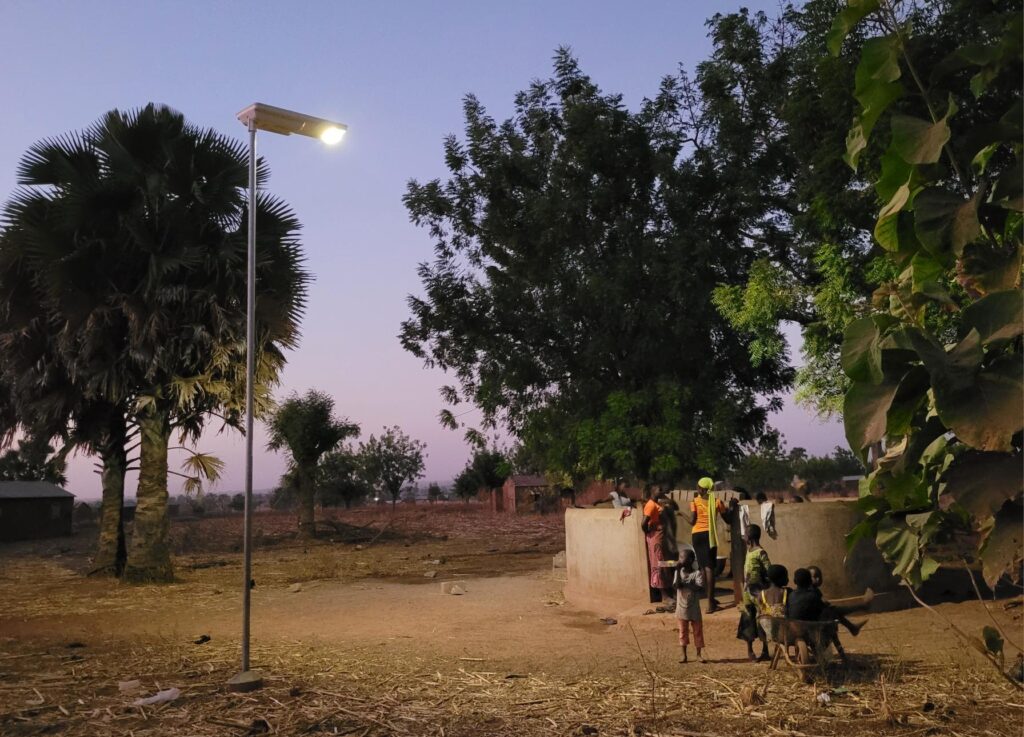
Overall well-being: 91% of residents report an improvement in their quality of life.
Nighttime activities: nighttime attendance increased from 8% to 23%.
Access to essential services: +30% nighttime visits to health centers and water points.
Education: 25% of students now study in the evening, compared with 1% previously.
Inclusion & women’s empowerment: 16% nighttime outings, strengthening social participation.
In rural areas, access to energy is not just about infrastructure. It affects the safety of mobility, access to healthcare, the continuation of economic activities and participation in social life after nightfall.
In Togo, this challenge was particularly significant. In 2018, only 8% of rural areas were electrified. To address this reality, the Togolese authorities, through AT2ER, launched the PEP’S Rural solar public lighting project, with a clear objective: to reduce territorial inequalities and support the economic and social development of rural communities.
Alongside the Togolese government, Sunna Design contributed to this ambition through the deployment of 50,000 autonomous solar streetlights across 4,599 communities. But beyond the number of systems installed, it is the concrete impact on residents’ daily lives that gives the project its full meaning.
To assess the effects of the program, a social impact study was carried out in the field with the support of Mitsio Motu. It was based on 5,429 interviews conducted in three key regions of the country: Savanes, Kara and Plateaux.
The aim was to compare the situation before and after the installation of the solar streetlights, in order to measure changes in usage, nighttime mobility, access to essential services, education and women’s autonomy.
This approach goes beyond a purely technical reading of the project. It shows how a solar infrastructure, when properly positioned and sustainably maintained, can become a genuine tool for social transformation.
One of the first observed effects concerns safety. In villages, on roads, near health centers, water points or gathering places, public lighting makes spaces more readable and more accessible.
According to the study, more than two out of three people are now satisfied with public lighting, compared with only 9% before the streetlights were installed. This figure reflects a profound change in the perception of public spaces.
Light does not eliminate all risks, but it improves visibility, strengthens the feeling of safety and encourages residents to move around more after sunset. In some areas, the feeling of nighttime safety increased by 11%, while frequent nighttime mobility rose significantly.
Solar lighting also has a direct impact on mobility and social activities. Before the project, darkness strongly limited movement. After the installation of the streetlights, 23% of residents said they frequently moved around at night for social or religious activities, compared with only 8% previously.
This evolution shows that public lighting is not limited to comfort. It supports local life, makes it easier for residents to gather and supports everyday uses.
Access to essential services has also improved. Nighttime attendance at public infrastructure, such as health centers and water points, increased by 30%. In rural areas, this improvement can have a decisive effect, especially for families, women and people living far from basic services.
The study also highlights a strong impact on education. Before the project, only 1% of students studied in the evening thanks to public lighting. After the deployment of the solar streetlights, this proportion reached 25%.
In territories where access to electricity remains limited, public lighting becomes an indirect but concrete support for learning. It provides young people with a more favorable environment to study, move around and take part in community life.
The impact is also visible for women. The percentage of women going out frequently at night rose from 4% to 16% after the streetlights were installed. This increase illustrates the role of lighting in autonomy, perceived safety and women’s social and economic participation.
The success of the project also relies on the quality of its implementation. Sunna Design deployed a methodology combining mapping, satellite pre-positioning and field studies.
This approach made it possible to identify priority areas, adapt the positioning of the streetlights to real uses and integrate feedback from local stakeholders: prefects, village chiefs and residents.
The project is also part of a long-term sustainability approach. Sunna Design planned a 12-year maintenance contract, combining preventive maintenance, corrective maintenance, geolocated digital tools and equipment monitoring. This dimension is essential to guarantee the long-term performance of the installations.
Beyond the social benefits, the project contributes to low-carbon electrification. By relying on solar energy, autonomous streetlights make it possible to light areas that are not connected to the grid, without using heavy infrastructure or highly emitting energy sources.
According to the study, the program prevents the emission of 701,631 kg of CO₂ each year, equivalent to 3.2 million kilometers traveled by a combustion-engine car.
This figure confirms that solar lighting can address two major challenges at the same time: improving people’s daily lives and reducing the environmental footprint of public infrastructure.
The impact study of the PEP’S Rural project in Togo shows that a solar streetlight can do much more than light a road. It can secure a journey, facilitate access to a health center, support education, strengthen women’s autonomy and extend local life after nightfall.
By combining solar innovation, field methodology, structured financing and long-term maintenance, this project demonstrates that it is possible to build infrastructure that is useful, sustainable and adapted to the needs of communities.
For Sunna Design, this study confirms a strong conviction: autonomous solar lighting is a concrete driver of territorial development. In Togo, light is now opening up new opportunities for thousands of rural communities.
The PEP’S Rural project aims to improve access to public lighting in rural areas of Togo through autonomous solar streetlights, in order to strengthen safety, inclusion and local development.
The project enabled the deployment of 50,000 solar streetlights across 4,599 rural communities.
The study shows an improvement in well-being, an increase in nighttime mobility, better access to health centers and water points, as well as support for education and women’s autonomy.
The program prevents the emission of 701,631 kg of CO₂ each year, equivalent to 3.2 million kilometers traveled by a combustion-engine car.
Sunna Design provides its expertise in autonomous solar lighting, with a complete solution including deployment, field methodology, technical supervision and 12-year maintenance.