About solar lighting 30 June 2026
Every summer, temperatures rise, heatwaves become more frequent, and one question often comes up: how can a solar street light continue to operate properly in 40 °C, 45 °C, or even higher temperatures?
It is sometimes assumed that the more sunshine there is, the better a solar solution performs. In reality, it is important to distinguish between two things: sunlight, which enables energy production, and heat, which can put certain components under stress.
A high-performance solar street light does more than simply generate energy from the sun. It must also be able to store that energy, protect its sensitive components, and adapt its operation to ensure reliable lighting, even in the most demanding environments.
This is where smart thermal management comes in: a comprehensive approach combining mechanical design, component protection, embedded electronics, and energy management.
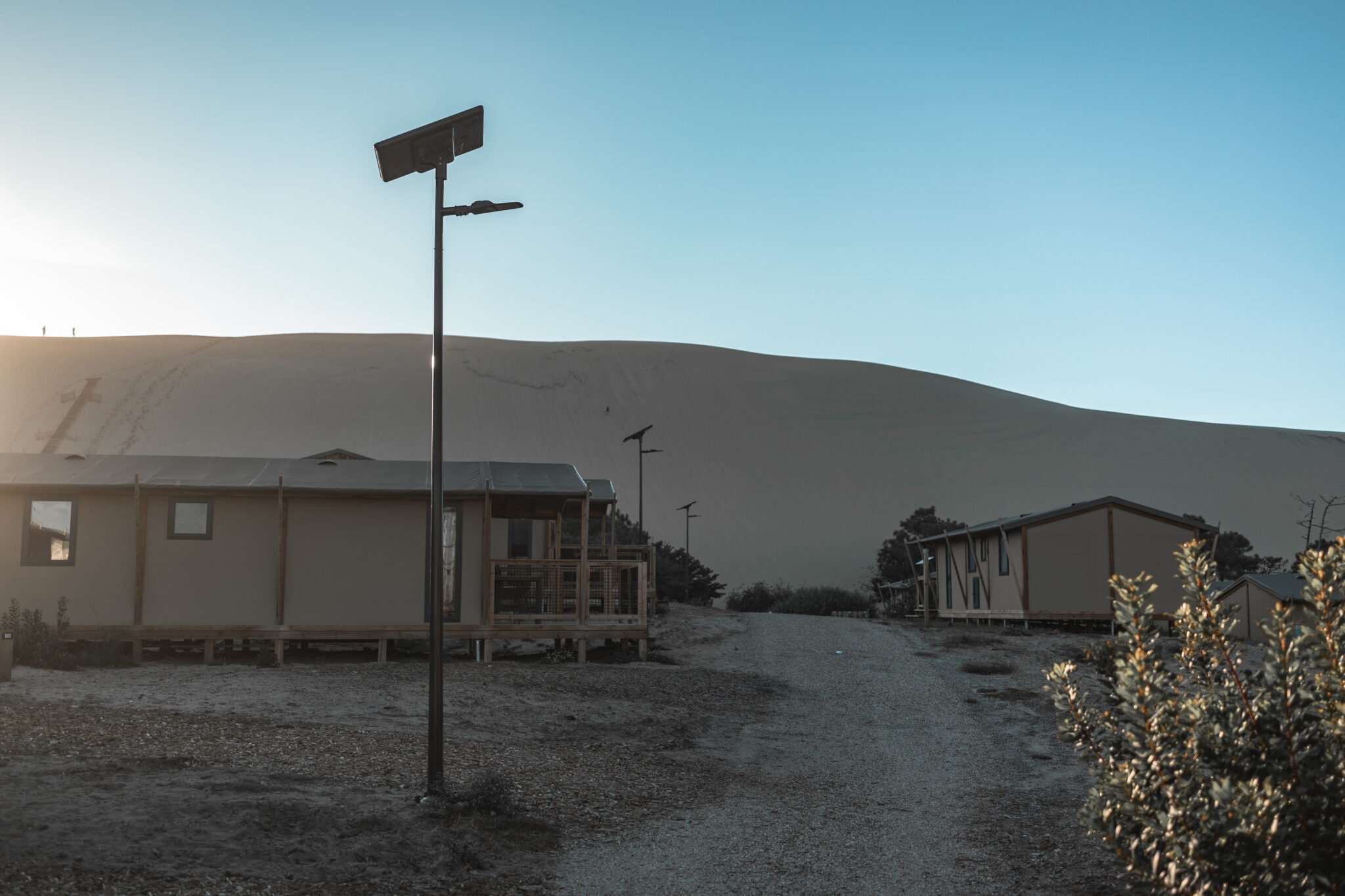
A standalone solar street light is a complete system. It combines several essential components: a photovoltaic panel, a battery, embedded electronics, and an LED lighting module.
When exposed to high temperatures, each of these components can be affected.
The battery is one of the most sensitive elements. It stores the energy produced during the day to power the lighting at night. Excessive exposure to heat can accelerate ageing and reduce its lifespan.
The embedded electronics must also be protected. They manage charging, discharging, lighting profiles, and the overall operation of the street light. To remain reliable, they must operate within controlled thermal conditions.
The photovoltaic panel is also affected. Even though it captures solar energy, its efficiency can decrease when its temperature rises too much.
Heat is therefore not just a one-off issue. When repeated day after day, it can become a factor of accelerated wear if it is not anticipated from the product design stage.
Smart thermal management refers to all the technical choices that allow a solar street light to limit the impact of heat on its components.
It relies on several complementary elements:
But thermal management is not only about evacuating hot air. It means considering the street light as a complete system, where each component is integrated to protect the whole: panel, battery, electronics, LED optics, and energy management algorithms.
The objective is not only to withstand one hot day. It is to ensure reliable lighting over several years, despite repeated sun exposure, temperature variations, and challenging weather conditions.
This global approach is what makes the difference between a simple solar street light and a standalone solution truly designed to last.
The design of a solar street light is not only a matter of aesthetics. It plays a direct role in the thermal performance of the system.
When a solar panel is exposed to the sun for several hours, it naturally accumulates heat. If this heat is not properly dissipated, it can be transferred to the sensitive areas of the street light.
This is why the mechanical design must promote natural airflow and limit heat build-up.
A well-designed structure helps to:
The street light then acts as a naturally ventilated system: hot air is evacuated, while cooler air circulates around sensitive areas. This principle can be simply illustrated with a thermal flow diagram, showing hot air outlets and cool air inlets.

This natural circulation helps limit heat build-up without adding complexity to the system.
Good design is therefore not only visible in the shape of the product. It can also be measured by its ability to protect components and extend the lifespan of the system.
In a standalone solar street light, the battery is at the heart of the system. It stores the solar energy produced during the day and releases it at night to power the lighting.
It is also one of the components most sensitive to temperature variations.
A battery’s lifespan does not only depend on its technology. It also depends on its operating conditions: temperature, charge and discharge cycles, level of demand, and depth of discharge, also known as DoD for “Depth of Discharge”.
The better a system controls these parameters, the better it can preserve the battery over time. This is why thermal management must be combined with smart energy management.
Embedded electronics also play a central role. They control energy flows, manage lighting profiles, protect the battery, and ensure the proper operation of the system.
By protecting the battery and electronics, smart thermal management protects the two elements that directly determine the reliability of a solar street light.
A modern solar street light is not simply made up of a panel, a battery, and a luminaire. It is an intelligent system, capable of managing available energy according to real site conditions.
Embedded intelligence optimizes the operation of the street light by taking several parameters into account: battery charge level, consumption, programmed lighting profiles, temperature, and the autonomy required to cover the entire night.
This smart management makes it possible to:
In practice, embedded electronics do more than simply operate the street light. They measure, analyze, and adjust essential parameters to maintain the balance between solar production, storage, consumption, and component lifespan.
This control is what gives full meaning to the concept of “smart thermal management”: heat is not treated as an isolated constraint, but as a parameter integrated into the overall performance of the system.
Thermal management is therefore not limited to heat dissipation. It is part of the global control of the street light, where every decision helps preserve performance, autonomy, and system lifespan.
A high-performance solar street light must not only operate in ideal conditions. It must remain reliable in demanding environments: heatwaves, tropical climates, remote areas, high temperature variations, or intense sun exposure.
In these contexts, performance cannot be measured only on a technical datasheet. It is proven in the field, year after year.
A well-designed system must be able to produce the necessary energy, store it efficiently, release it at the right time, and protect its components from external constraints.
This is particularly important for local authorities, developers, and companies looking for a reliable lighting solution that is durable and requires little maintenance.
In the face of extreme heat, smart thermal management becomes a key factor for reliability. It helps preserve components, maintain continuity of service, and guarantee standalone lighting over the long term.
Yes, a solar street light can operate during a heatwave, provided that its design is adapted to high temperatures. Thermal management, battery protection, and embedded electronics then play an essential role.
Heat can affect the efficiency of the photovoltaic panel, the behavior of the battery, and the lifespan of electronic components. That is why it must be anticipated from the system design stage.
The most sensitive components are generally the battery and the management electronics. They must be protected to ensure the reliability and longevity of the solar street light.
We talk about smart thermal management when heat dissipation is combined with a global system design: airflow, component protection, embedded electronics, and energy management.
Because performance depends on the entire system: solar energy production, energy storage, battery management, embedded electronics, lighting profiles, and long-term component protection.