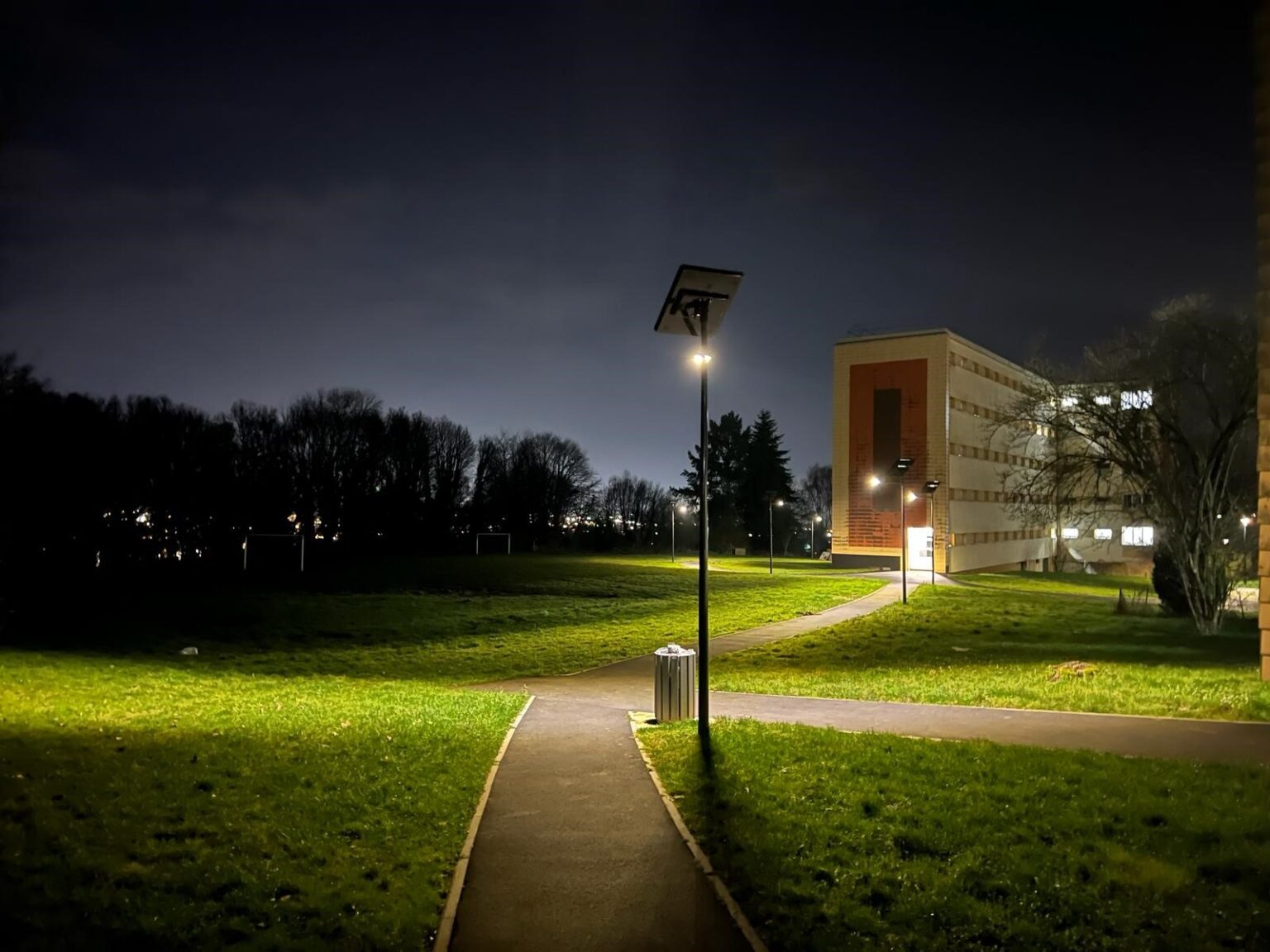
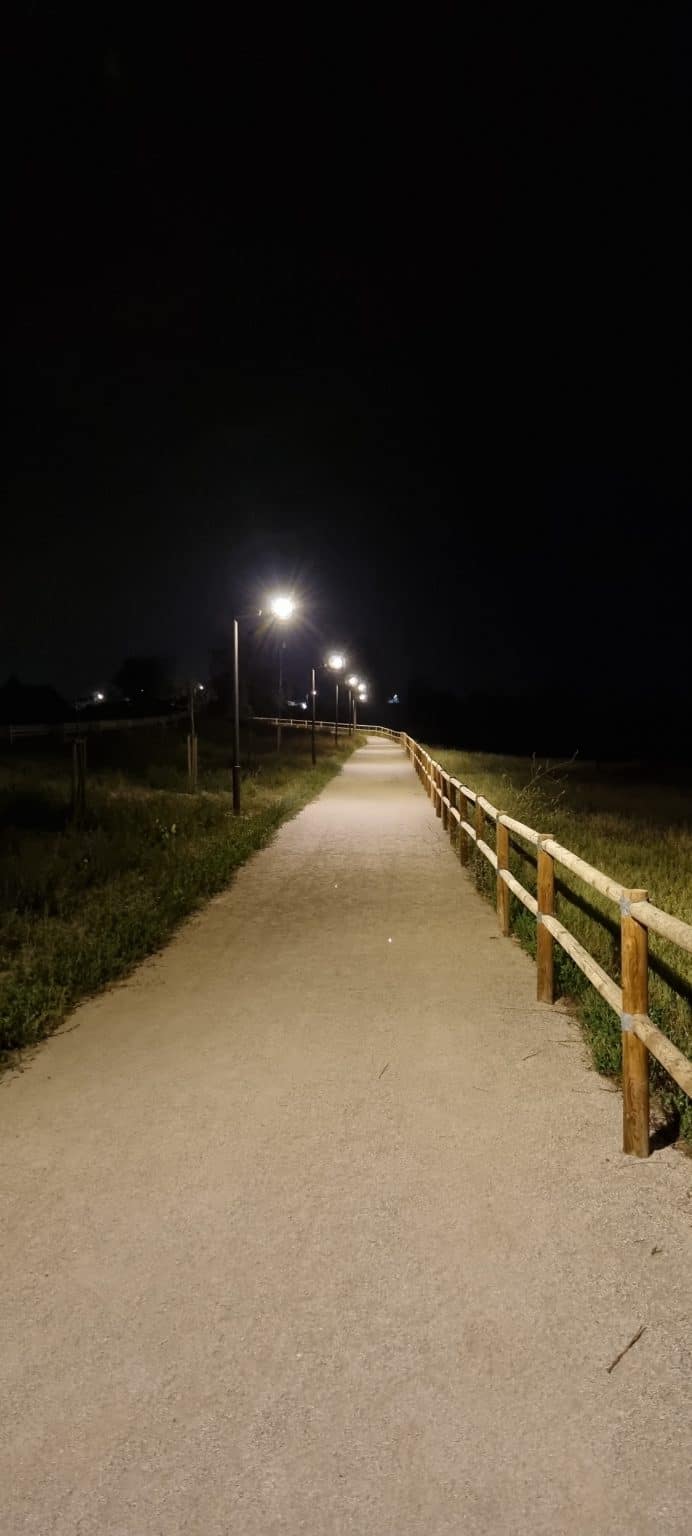
The lighting of pedestrian walkways is a specific challenge for public lighting. Crosswalk, country lane, seaside promenade, paths used by foot require lighting capable of adapting to all terrains, powerful without being dazzling, safe so that the paths remain accessible at night without lighting unnecessarily. This is what autonomous lighting allows.

Pathways and pedestrian crossings come in many different configurations: road crossing, promenade, rural path, park walkway, site access, campus or business area.
The autonomous solar lighting provides a solution adapted to these environments, even when they are far from the electrical grid. Without trenching or connection, it makes it easier to install light points where the needs are precise and localized.
Thanks to smart lighting management, the light can be adapted to real uses: securing movements, guiding crossings and limiting unnecessary lighting when foot traffic is lower.
Solar lighting for a pedestrian path is installed without trenching, without cabling and without connection to the electrical grid. It makes it possible to quickly light a pedestrian crossing, a walkway, a promenade or a building access, even when the area is far from existing infrastructure.
Appropriate lighting improves night-time visibility and the readability of pedestrian pathways. It supports users as they move along paths, pedestrian crossings, soft mobility routes, campuses, parks or business areas, while providing comfortable and controlled lighting.
Autonomous solar streetlights meet the needs of rural areas, isolated sites, housing developments, promenades or access points far from the electrical grid. They make it possible to add targeted light points where pedestrians circulate, without requiring major infrastructure works.
Thanks to smart lighting management, light can be adapted to real usage and periods of attendance. This approach makes it possible to light pedestrian pathways at the right time, limit unnecessary lighting and control energy consumption.

Solar lighting for pedestrian pathways meets many development needs, both in urban areas and in rural areas.
It can be deployed to secure a pedestrian crossing, guide movement between a parking lot and a building entrance, light a promenade, support access to a campus, make a residential path easier to read or improve circulation in a business area.
This approach is particularly relevant when the lighting need is localized: just a few light points can be enough to make a route more visible, more comfortable and more accessible, without requiring major infrastructure works.
Our experts support you in designing a solution adapted to your technical, economic and environmental challenges.
Located along the East River, Pier 42 is today one of New York City’s most emblematic urban redevelopment projects. Long occupied by port and industrial infrastructure, the site has been transformed into a contemporary public park, designed to reconnect Lower East Side residents with their waterfront. Within this large-scale project, public lighting plays a […]
In the heart of Mont-Saint-Aignan, near Rouen, the Crous Normandie has launched an ambitious project combining energy renovation, accessibility, and sustainability. At the centre of this initiative lies the Flaubert building within the Panorama residence, where a new generation of solar-powered lighting now illuminates the student pathways. Supported by the French Government’s Recovery Plan […]
In Bordeaux, the Pont Saint-Jean is stepping into a new era with a tailor-made solar lighting solution by Sunna Design. This flagship project, part of the ambitious Euratlantique development program, embodies the blend of sustainable innovation and architectural heritage preservation. The solar lighting installed provides a contemporary illumination that highlights the bridge’s design while […]
In Sant Llorenç d’Hortons, a path connecting the residential area to an industrial hub was left in darkness. Used daily by workers and residents, it posed a safety concern. The municipality chose to address this by installing iSSL+ solar streetlights. A fully autonomous solution ideally suited for this natural setting. Path and […]
Solar lighting makes it possible to bring light to areas that are sometimes far from the electrical grid, without major connection works. It is particularly suitable for pedestrian pathways, access points, crossings and soft mobility areas.
Solar streetlights can be installed on pedestrian crossings, pedestrian paths, promenades, soft mobility routes, building access areas, campuses, business areas, housing developments or isolated sites.
Yes, provided that the solution is properly sized according to usage, foot traffic, the environment and the required lighting level.
Yes. This is one of the main advantages of autonomous solar lighting: it works without being connected to the grid, which makes installation easier in existing or remote areas.