Located in La Marsa, Tunisia, the Golden Carthage Hotel & Residence has chosen autonomous solar lighting to improve guest comfort after dark while reducing its reliance on the electricity grid.
For this project, initiated in 2023, Sunna Design worked alongside its local partner Ifrikia Solis to provide lighting tailored to the various areas of the hotel complex: access roads, parking areas, pedestrian pathways and reception areas.
Road lighting, parking areas and pedestrian pathways
Golden Carthage, La Marsa – TUNISIA
36 solar streetlights specified – iSSL, UP and EverGen ranges
Motion detection and smart energy management

Situated in the hills above La Marsa, Tunisia, near the Mediterranean coast, the Golden Carthage Hotel & Residence is a five-star establishment offering guests a distinctive setting that combines architecture, landscaped gardens and panoramic sea views.
In the hospitality and tourism sector, the quality of outdoor lighting plays an important role in the guest experience. From building entrances to gardens and recreational areas, lighting guides guests and helps create a welcoming and reassuring atmosphere after dark.
As part of its efforts to improve energy efficiency and preserve its surroundings, the hotel turned to Sunna Design’s autonomous solar lighting solutions. The objective was to enhance its outdoor spaces while reducing its consumption of grid electricity.

At Golden Carthage, each outdoor area has different lighting requirements: good visibility for drivers, comfortable lighting for pedestrians and a welcoming atmosphere around reception and recreational areas.
The challenge was therefore to design a lighting solution tailored to each application, while taking into account existing infrastructure, the surrounding landscape and the hotel’s energy objectives.
The project aimed to achieve several objectives:
improve visibility and comfort for guests moving around the site at night
adapt lighting levels and light distribution to each outdoor area
avoid grid connection works and preserve existing landscaping
optimise energy consumption and limit light pollution
ensure that the equipment blends harmoniously into the hotel’s architecture and landscape
By generating and storing their own energy, autonomous solar streetlights offer greater installation flexibility, making it possible to illuminate areas where lighting is needed, regardless of their proximity to the electricity grid.

To address the different requirements of Golden Carthage, Sunna Design conducted two complementary studies: a photometric study to determine lighting levels and light distribution, and an energy autonomy study taking into account local solar irradiation and the energy requirements of each lighting unit.
The project design specifies 36 autonomous solar streetlights, distributed across six models from three complementary product ranges: iSSL, UP and EverGen.
9 iSSL+ with motion detection for pedestrian pathways
15 iSSL Maxi Road for access roads and the entrance roundabout
6 iSSL Maxi4 Area for the parking area
2 UP2 and 3 UP4 for the reception area
1 EverGen-L (80 W) to complement the lighting of the reception area
With mounting heights ranging from 4 to 8 metres, the lighting design takes into account the site layout, the surfaces to be illuminated and the visibility requirements of each application.
The choice of colour temperatures follows the same approach: 3000 K warm white lighting is specified for pedestrian pathways to create a welcoming atmosphere, while 4000 K neutral white lighting is selected for roads, parking areas and reception spaces.

A hotel’s lighting requirements change throughout the night depending on how its outdoor spaces are used. To balance visual comfort and energy autonomy, Sunna Design studied three lighting profiles tailored to the different applications at Golden Carthage.
Profile C with motion detection: along pedestrian pathways, iSSL+ streetlights adjust their light output in response to guest movements. During the middle of the night, lighting increases from 20% to 100% when motion is detected.
Profile A without motion detection: for roads and parking areas, the profile specifies lighting at 100% for the first three hours of the night, then at 40%, before returning to 100% during the final hour before dawn.
Profile M without motion detection: for the reception area, the profile specifies lighting at 100% for the first five hours of the night, then at 40%, before returning to 100% during the final hour before dawn.
At the heart of this energy management system, the patented SunnaCore embedded electronics automatically regulate light output according to the energy available in the battery and solar irradiation conditions.
Combining programmed lighting profiles with smart energy management helps optimise system autonomy. Energy simulations conducted for Golden Carthage predict lighting availability 365 nights a year, even under unfavourable climatic conditions.

The installations at Golden Carthage demonstrate how autonomous solar lighting can address multiple requirements within a single hotel complex, from access roads to reception areas.
Sunna Design’s photometric studies covered five distinct areas, with particular attention paid to lighting levels, uniformity and light distribution according to each application:
Pedestrian pathways: guide guests with comfortable, warm lighting.
Parking area: facilitate vehicle manoeuvres and pedestrian movement between parked vehicles.
Access road and entrance roundabout: support driver visibility and make access routes easier to navigate.
Reception area: enhance welcoming spaces and their surrounding landscape.
This tailored approach makes it possible to define suitable streetlight layouts and light distribution for each area, rather than applying the same lighting level across the entire site.
The project illustrates the opportunities offered by solar lighting for private businesses looking to combine quality of service, controlled operating costs and the transition to renewable energy.
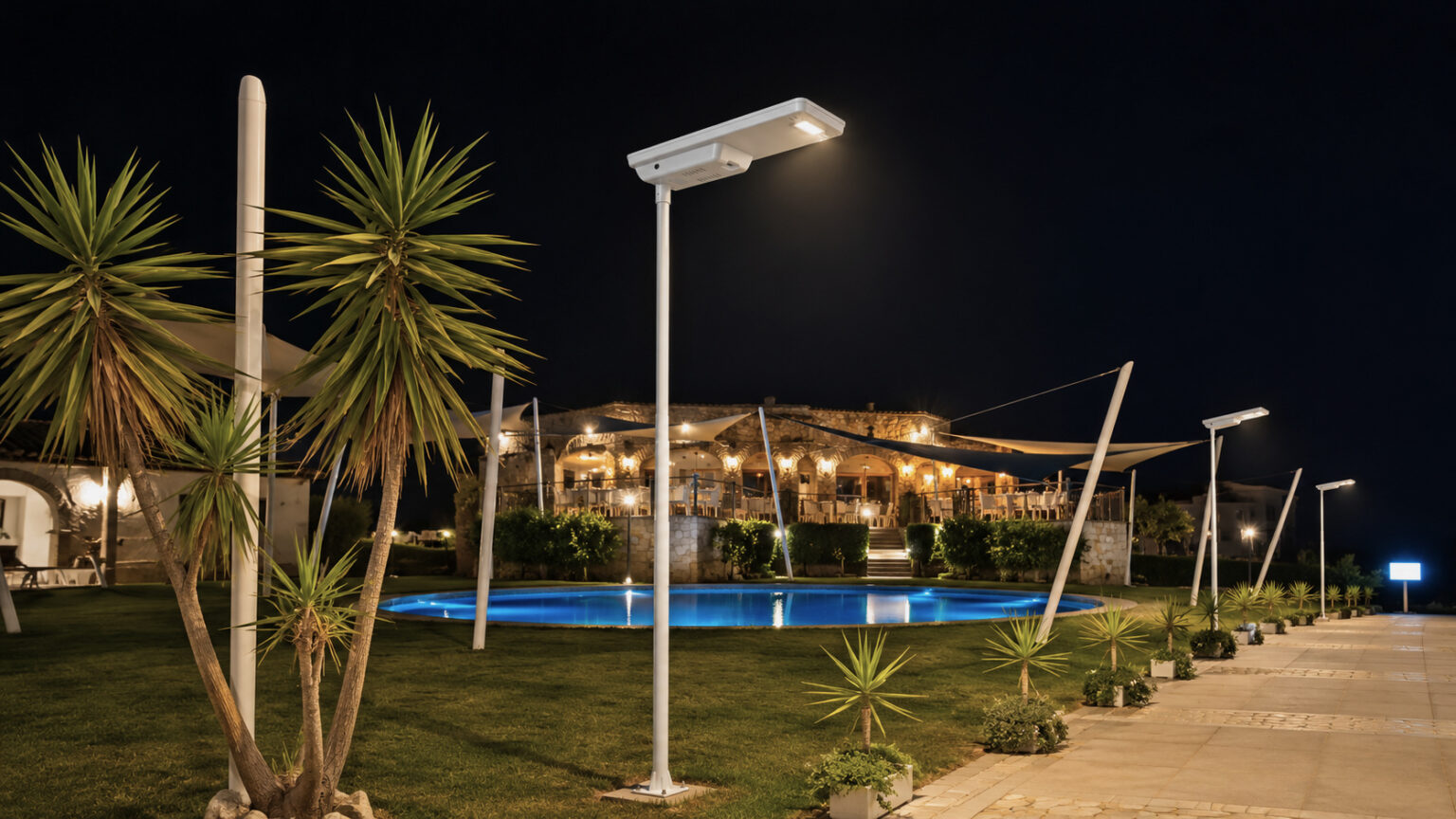
Whether developing a new hotel complex or renovating an existing property, autonomous solar lighting offers greater flexibility when designing gardens, pathways, parking areas, building entrances and recreational spaces.
By eliminating the need to connect streetlights to the electricity grid, this solution helps reduce civil engineering works, preserve existing landscaping and control electricity costs.
For hospitality and tourism professionals, solar lighting provides an opportunity to combine an enhanced guest experience, energy efficiency and sustainable property development.
With its expertise in lighting design and its comprehensive range of solar streetlights, Sunna Design supports professionals in developing solutions tailored to the applications, architectural constraints and climatic conditions of each project, in France and worldwide.
Looking to equip your hotel or resort with autonomous solar lighting? Speak with our experts to design a solution tailored to your property.


Our experts help you design an autonomous solar lighting solution tailored to your outdoor spaces, lighting requirements and environmental objectives.
At Alam Impian Park, in Malaysia, Sunna Design supports the lighting of a public space through a combination of autonomous solar solutions adapted to the site’s different uses: pathway lighting, architectural wayfinding and landscape enhancement. Carried out for the municipality and […]
Located along the East River, Pier 42 is today one of New York City’s most emblematic urban redevelopment projects. Long occupied by port and industrial infrastructure, the site has been transformed into a contemporary public park, designed to reconnect Lower East Side residents with their waterfront. Within this large-scale project, public lighting plays a […]
In the lush province of Catania, the “Jean Calogero” park in Cannizzaro, Aci Castello, pays homage to the famous local painter within a natural, relaxing setting. Opened in March 2023, the park now features a children’s playground, a fitness area, and a dog relaxation zone. Driven by Mayor Dr. Carmelo Scandurra and in collaboration […]
In today’s world, sustainability is at the forefront of municipal concerns. Cities are actively seeking innovative solutions that merge ecological benefits with efficiency. Within this framework, the town of Lesparre-Médoc, in Gironde, has opted for Sunna Design’s autonomous solar lighting solutions to equip its athletic areas, including high jump and long jump tracks. Parc […]