About solar lighting 24 September 2026
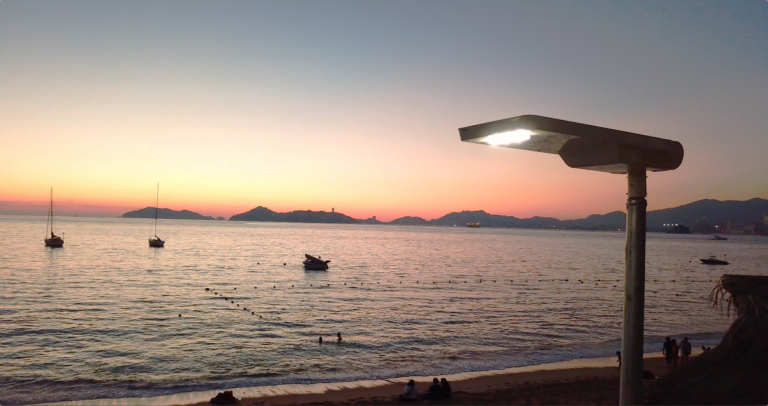
Seafront promenades, coastal cycle paths, beach parking areas, marinas or coastal roads: there are many needs for public lighting along the coast. However, these environments also expose outdoor equipment to specific constraints.
Salt, sea spray, humidity, wind and even sand can accelerate the ageing of installations when they are not designed with suitable materials and levels of protection.
In this context, one question often arises: can a solar street light be as reliable as conventional public lighting in a coastal area?
The answer is yes, provided that the solution is designed and sized for its environment. Solar lighting is not inherently more vulnerable to marine conditions. As with any outdoor lighting equipment, its resistance primarily depends on the materials used, corrosion protection, sealing and mechanical design. With one additional advantage: a solar street light produces and stores its energy locally, without requiring an electrical network between the different lighting points.
Close to the coast, public lighting equipment is exposed to specific conditions. Marine air and sea spray carry salt particles that settle on surfaces and, combined with humidity, can promote corrosion.
The choice of materials, surface treatments, fasteners and coatings therefore becomes essential to ensure the durability of the installation.
Proximity to the coastline is a key factor to consider. Even without direct exposure to seawater projections, a saline atmosphere can subject equipment to significant constraints. The closer the site is to the sea and the more exposed it is to sea spray, the more demanding the choice of materials and protection systems must be.
Humidity and water projections must also be taken into account. A LED street light, whether solar-powered or conventional, contains several electrical and electronic components that must be protected against water, dust and ingress. IP ratings are used in particular to characterize the level of protection provided by enclosures.
Finally, seafronts and coastal infrastructure are often highly exposed to wind. The resistance of a solar lighting pole depends on many parameters: pole height, photovoltaic panel surface area, luminaire, site characteristics and foundations. Mechanical sizing must therefore be carried out according to the site and the selected configuration.
For structures and components made of steel, environments can be classified according to their corrosivity level. This classification helps adapt protection systems to the conditions to which the metal will be exposed.
It is a particularly useful reference for projects located in urban, industrial or marine atmospheres. For components made of aluminium or plastic, resistance to saline environments depends more on the properties of the materials and the product design.
| Category | Corrosivity level | Examples of environments |
|---|---|---|
| C1 | Very low | Mainly dry indoor environments |
| C2 | Low | Rural areas with low pollution |
| C3 | Medium | Urban and industrial atmospheres with moderate pollution |
| C4 | High | Industrial areas with high humidity or particularly demanding atmospheres |
| C5 | Very high | Highly corrosive industrial areas and coastal environments |
| CX | Extreme | Marine, offshore or particularly aggressive environments |
This scale illustrates why solar lighting projects in coastal areas require particular attention. In a marine environment, reinforced protection or the use of materials that are naturally resistant to corrosion becomes essential to ensure the long-term durability of the installation.
When applied to steel structures, C3 and C5 indicate the corrosivity category of the environment. The letters H and M refer to the durability level of the protection system.
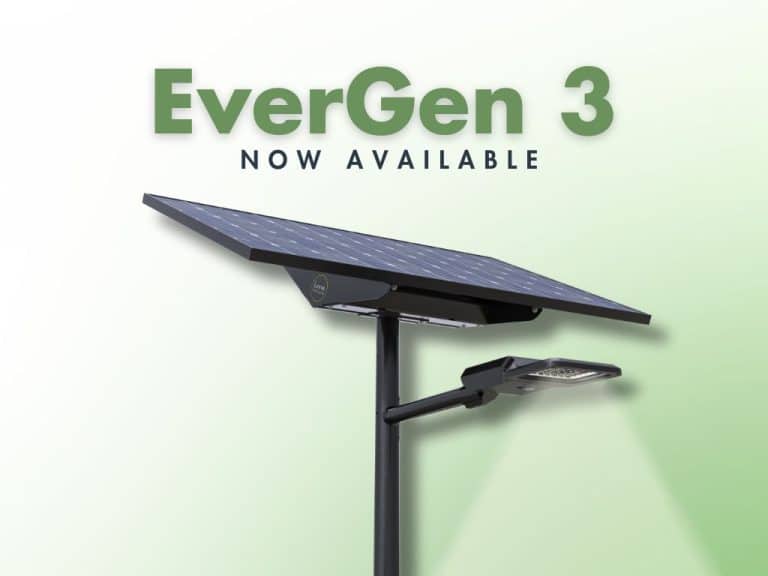
On the EverGen 3, whose mechanical structure is made of steel, the standard protection is C3H. For projects located in more corrosive environments, a reinforced C5M configuration is also available.
This reinforced protection is particularly relevant for coastal cities, industrial environments or sites exposed to a corrosive atmosphere. For installations directly exposed to the seafront and sea spray, the choice of solution must also take into account the nature of the materials, the components used and the site’s actual exposure level.
Key takeaway: in a coastal environment, corrosion resistance must be considered from the design stage of the project. Depending on proximity to the sea and exposure level, the solution may rely on reinforced protection for steel components or on materials particularly suited to saline atmospheres.
Solar power does not change the fundamentals of a public lighting project. Whether connected to the grid or autonomous, a street light must be able to withstand the constraints of its environment: corrosion, humidity, wind, water and dust.
A solar lighting solution mainly adds a photovoltaic panel, a battery and an energy management system. These components must also be protected and integrated into an architecture suited to the site conditions.
The choice of materials is also an important factor. Steel with reinforced anticorrosion treatment, aluminium or polymer materials can be used depending on the street light design and its installation environment.
The right question is therefore not simply whether solar lighting is as resistant as conventional lighting, but whether the chosen solution is properly designed for the actual constraints of the project.
A properly engineered autonomous solar lighting system can therefore provide the resistance required for coastal environments while delivering the benefits of solar energy.
One of the main advantages of a solar street light is its autonomous operation. Each lighting point produces and stores locally the energy required for its operation.
There is therefore no need to create a continuous electrical supply between the different street lights. Depending on the project, this can help reduce:
This advantage is particularly relevant for linear infrastructure such as cycle paths and greenways, coastal promenades or coastal roads.
On an already developed seafront, creating a conventional lighting network may require work on a road, promenade, landscaped area or cycle path. With autonomous solar lighting, each lighting point operates independently from the grid, which can simplify deployment and reduce certain civil engineering works.
This autonomy is also particularly valuable in areas located far from an existing electrical supply: beach parking areas, peripheral roads, promenades or paths and pedestrian crossings.
The reliability of a solar lighting project in a coastal area depends above all on the quality of the preliminary study. Several parameters must be analysed together.
1. Analyse the site environment
Distance from the coastline, exposure to sea spray, prevailing winds, humidity and the presence of sand must all be taken into account. In a coastal environment, saline air itself represents a significant constraint, even when the site is not directly exposed to seawater projections.
2. Define the lighting requirement
Road width, type of users, required illuminance level, uniformity and operating hours make it possible to determine the expected performance of the LED luminaire. A solar project should always start with the photometric requirement, not with the size of the photovoltaic panel.
3. Size solar production and energy storage
Available solar resources, LED power, the nighttime lighting profile and required autonomy are then used to size the photovoltaic production and energy storage capacity.
4. Adapt materials and corrosion protection
In a coastal environment, reinforced corrosion resistance is essential. Depending on proximity to the sea and the site’s exposure, this can be achieved through appropriate anticorrosion treatment on steel components or by using materials that are naturally resistant to saline atmospheres.

Simplified examples of environments according to their corrosivity level. The protection level of equipment should be defined according to the materials used and the actual project conditions.
5. Integrate mechanical constraints
Finally, the pole, solar panel, foundations and entire structure must be sized according to wind exposure and site characteristics.
There are many applications for solar lighting by the sea. An autonomous solution can be considered for:
In each of these applications, an LED solar street light combines energy autonomy, lighting performance and the absence of an electrical network between the different lighting points. The product range and materials simply need to be selected according to the site’s level of saline exposure.
Thanks to its robust design and different configurations, the EverGen 3 can be adapted to projects located in particularly demanding environments.
Its steel mechanical structure comes with C3H protection as standard. For coastal cities, industrial areas or sites exposed to a more corrosive atmosphere, a C5M option provides reinforced protection for the system.
For installations located closest to the coastline or directly exposed to sea spray, Sunna Design takes a broader approach by adapting the solution to the project context, considering materials, components, photometric requirements, mechanical constraints and available solar resources.
This adaptability makes it possible to provide a solar lighting solution consistent with the actual constraints of the site, from coastal cities to the most demanding marine environments.
Salt, sea spray, humidity and wind are primarily engineering constraints. They do not make solar lighting incompatible with coastal areas.
The coastline is simply an environment that requires suitable materials, protection systems and sizing. With a properly selected solution, solar lighting can effectively meet these constraints while providing a particularly relevant advantage: the ability to provide lighting without deploying an electrical network between the different lighting points.
This autonomy makes solar lighting particularly attractive for many coastal development projects, including promenades, cycle paths, parking areas, roads, marinas and sites located far from existing infrastructure.
Yes. The materials, components and protection systems must be suited to the site’s constraints: salinity, humidity, wind, water projections and exposure to sea spray.
Coastal environments require reinforced corrosion protection. For steel components, a C5 level is particularly suitable for coastal atmospheres. The precise choice then depends on the site’s exposure and the materials used.
C3 and C5 indicate the corrosivity level of the environment, while H and M refer to the durability of the protection system. On EverGen 3, C5M is a reinforced option for more corrosive environments, particularly coastal cities.