About solar lighting April 2026
Choosing a professional solar street light for a parking lot or roadway is not just about comparing power levels or prices. To achieve reliable, durable lighting that fits the site, it is important to consider the actual use case, the area to be covered, the expected autonomy and the specific constraints of the location.
A company parking lot, a secondary road, a pedestrian area or a public space do not have the same requirements. The right choice therefore depends first and foremost on the project itself. Here are the key criteria for sizing a professional solar lighting solution effectively.
Contents
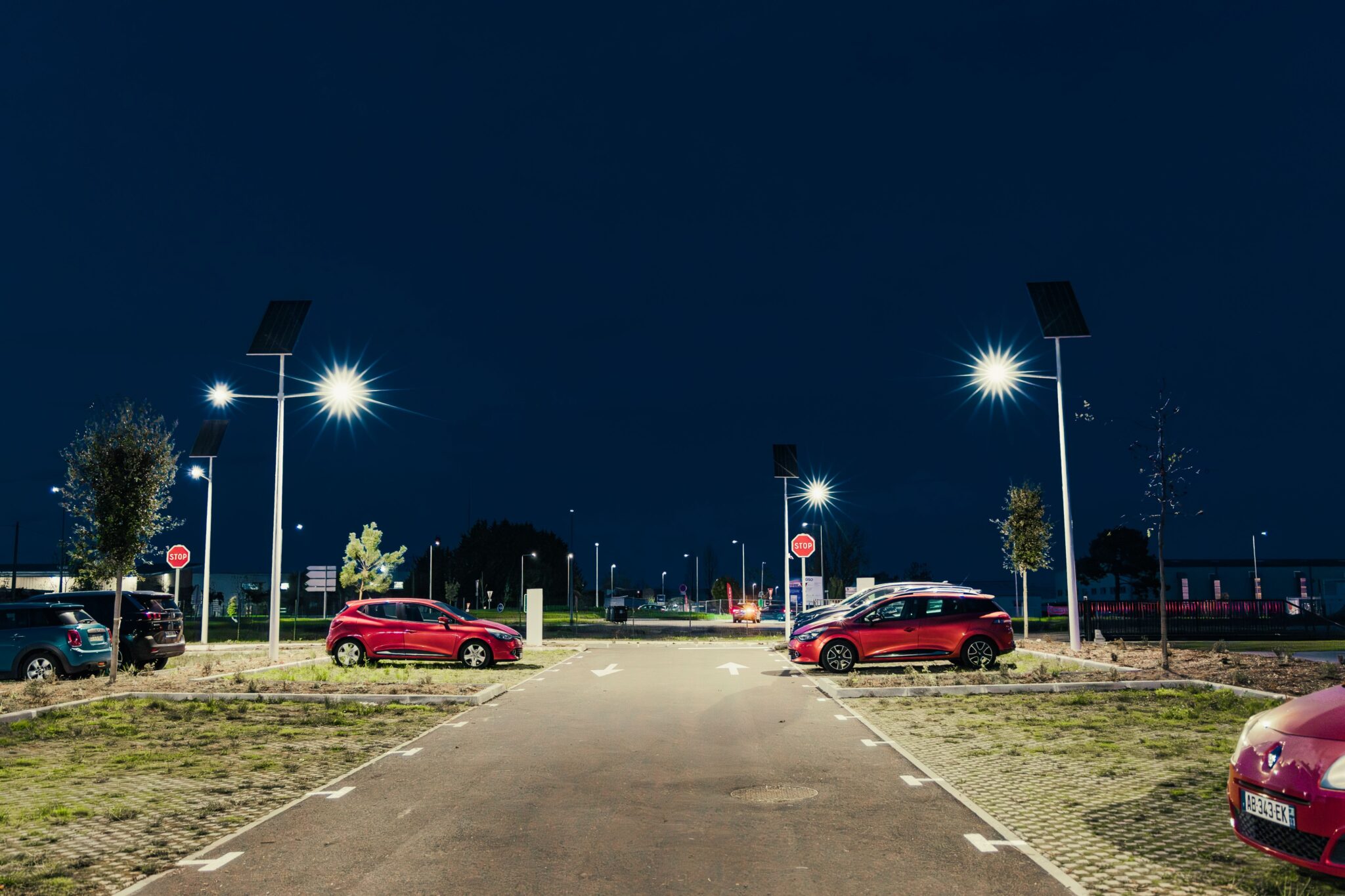
Solar lighting designed for professional or public use has nothing in common with decorative or residential lighting. In a parking lot or on a roadway, the goal is not simply to provide light. It must also improve safety, reduce shadowed areas and ensure consistent performance over time.
The right choice therefore depends on how well the solution matches the actual need and the site configuration. Two projects may use products that look similar on paper and still deliver very different results depending on layout, solar exposure, pole height or usage profile.
It is also important to think in terms of total project cost. In a solar public lighting or solar parking lighting project, the product price is only part of the equation. Installation, pole structure, maintenance and the works avoided thanks to an autonomous solution must also be taken into account.
Before comparing models, the first step is to clearly define the area to be lit.
In a company, commercial or public parking lot, lighting must secure traffic flows, access points, parking spaces and pedestrian routes. Key factors include:
the total surface area
the number of parking spaces
operating hours
the level of nighttime use
A residential street, a secondary road or an access road in a business area will not require the same level of performance. In the case of a project led by a local authority or public body, the choice must also take into account uses, operating constraints and the area’s energy sobriety objectives.
the length of the section to be lit
road width
traffic levels
the presence of intersections or sensitive points
On a pathway, in a park, a residential development or an off-grid area, the objective may be different: guiding movement, securing a passage, limiting connection works or protecting biodiversity.
Choosing a professional solar street light is based on several key criteria. The objective is not simply to compare product specifications, but to assess the most relevant solution according to the site’s actual use.
Requirements vary depending on the application. A small parking lot with limited traffic will not require the same sizing as a roadway or a sensitive site. Power should always be assessed in relation to the area to be lit, traffic levels and the expected lighting performance.
The size of the parking lot or the length of the roadway determines how many lighting points are needed. Access points, blind spots, crossing areas and pedestrian routes must also be taken into account.
Pole height affects coverage, visual comfort and lighting uniformity. It must be consistent with the area to be lit, the distance between lighting points and the required service level.
A professional solar street light must remain effective even when solar exposure decreases. Autonomy depends on the battery, the energy management strategy and the selected lighting profile. It must be designed according to actual uses and local constraints.
Orientation, shading, trees, nearby buildings or topography can strongly affect performance. A good solar project always starts with an analysis of the real site conditions.
For professional use, it is essential to assess the quality of the system design, its resistance to outdoor conditions, its long-term reliability and its suitability for site constraints.
There is no single power level that works for every project.
In a limited-size area, the objective is to secure movements without oversizing the installation. The right choice is based on lighting that is coherent, readable and suited to actual site use.
As usage increases, so do performance requirements. It may therefore be necessary to strengthen lighting coverage, improve uniformity and define operating scenarios that match the site’s schedule.
On a roadway, power alone is not enough. Visual continuity must also be ensured, in line with traffic conditions and road width.
For an industrial site, a logistics access point or an area with higher safety requirements, a high-output professional solar outdoor lighting solution may be more appropriate. In this case, sizing must be particularly rigorous.
A professional solar street light is not the only possible configuration. Depending on the area to be lit, the level of use and site constraints, a solar bollard or a hybrid solution may also be relevant.
A solar street light is generally the most suitable solution for lighting a parking lot, roadway, public space or pathway with uniform coverage. It helps secure movement, structure the space and provide a consistent lighting level across larger areas.
The solar bollard addresses different needs. It is particularly suitable for marking a pathway, supporting pedestrian movement, improving route visibility or treating areas where low-height lighting is sufficient.
In some contexts, a solar + grid hybrid configuration can be an effective compromise. It preserves the benefits of a solar approach while securing operation on more demanding sites, where usage conditions or installation constraints require stronger continuity of service.
The right choice depends above all on the intended function: providing uniform lighting, marking a route or securing a site with specific constraints. A relevant solution can only be defined through an analysis of the site, its uses and the expected service level.
Some mistakes occur frequently in solar lighting projects.
A cheaper product can become more expensive if it lacks sufficient power, autonomy or robustness.
Access points, traffic areas, crossings and actual site uses must all be considered.
Region, orientation and shading directly affect system performance.
A public or private site with operational requirements needs a solution designed for professional use.
The right choice always depends on the purpose: securing, guiding, marking or ensuring lighting continuity.
The budget depends on several factors:
power level
pole height
autonomy
battery type
the number of lighting points
control options
site constraints
installation
In many cases, solar becomes competitive because it avoids grid connection works, trenching and certain infrastructure constraints.
The most relevant approach is to think in terms of total project cost, rather than purchase price alone.
Professional solar lighting is particularly relevant in the following cases:
Solar makes it possible to provide lighting without heavy connection works.
When additional lighting points are needed quickly, an autonomous solution can simplify the project. This is notably the case on certain industrial sites and parking areas equipped with solar lighting, where fast installation and limited works provide a clear advantage.
When deadlines, construction budgets or the impact of works are critical, solar can provide a real advantage.
To secure an access point or a traffic area quickly, solar lighting can be more flexible than a conventional installation.
A good project starts with a clearly defined need.
a plan
the surface area or linear distance
access points
sensitive points
main uses
To obtain a relevant recommendation, it is useful to specify the desired operating hours, the expected lighting level, any site constraints and the specific use characteristics of the area to be lit.
The clearer the starting information, the more relevant the recommendation will be.
Choosing a professional solar street light for a parking lot or roadway means answering a few simple questions: what exactly needs to be lit, for what purpose, at what intensity and for how long?
The right choice is not necessarily the most powerful one, but the one that responds precisely to the site’s actual needs. A well-sized project helps secure uses, limit installation constraints and optimize overall performance.
The right choice depends on the area to be covered, the level of use, pole height, the expected autonomy and the type of traffic on the site.
Power varies depending on the project. It should be defined according to the area to be lit, the level of use and the expected result.
Yes, provided it is correctly sized. Autonomy, battery capacity, lighting control and the site’s solar exposure are key factors.
A site assessment helps define the most suitable configuration based on your objectives and constraints.