About solar lighting March 2026
Over 20 years, most of the environmental impact of public lighting does not come solely from the product… but from its use, installation and end-of-life. Today, local authorities and engineering firms face a dual challenge: reducing costs while meeting climate and regulatory requirements. In this context, the life cycle of equipment is becoming an increasingly structuring criterion. And this is precisely where autonomous solar lighting stands out.

For a long time, lighting projects were designed based on installation cost alone. Today, this approach is reaching its limits.
The integration of total cost of ownership (TCO) is gradually becoming essential, taking into account the entire life cycle: installation, operation, maintenance and end-of-life.
This shift is also driven by the regulatory framework. The AGEC law, responsible public procurement policies and carbon neutrality targets encourage the adoption of sustainable, repairable and low-emission solutions.
In this context, a high-performance solution is no longer just one that provides lighting, but one that minimizes its impact over 20 years.
Product life cycle analyses carried out on Sunna Design solutions show a carbon footprint between 98 and 167 kg CO₂ eq, depending on the models and scope considered.
Unlike conventional lighting, this footprint is almost entirely concentrated in the manufacturing and transport phases. During the use phase, a solar streetlight consumes no energy from the grid.
This means in practical terms: no dependency on the grid and long-term cost control.
This model is based on an eco-design approach: modular equipment, repairable components, and the use of recyclable materials.
These principles are detailed in our CSR approach.
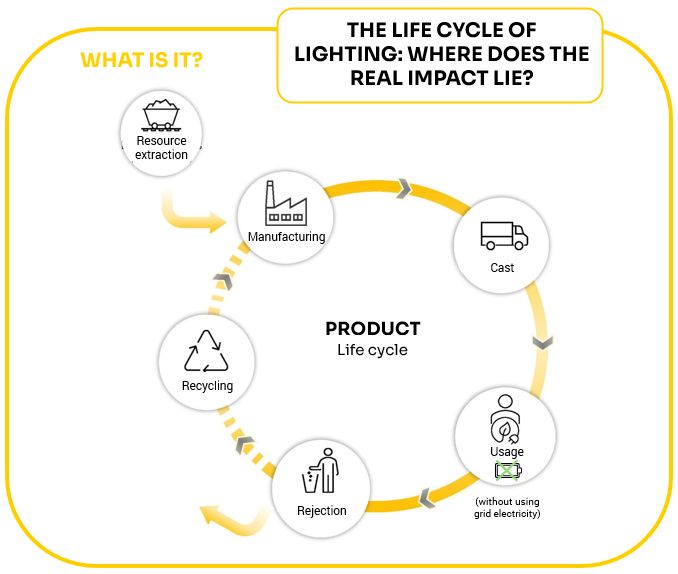
Life Cycle Assessment (LCA) evaluates the environmental impact of a streetlight across its entire life cycle: manufacturing, installation, use and end-of-life.
In the case of solar lighting, this analysis highlights a key point: most of the impact is concentrated during manufacturing.
Unlike grid-connected lighting, which consumes energy throughout its lifetime, a solar streetlight no longer emits during the operation phase.
This specificity allows action on the most effective levers: eco-design, material selection and recyclability optimization.
Sunna Design follows this global approach by combining technical performance with environmental impact control.
“Impact is not only determined at purchase, but over the entire life cycle.”
An analysis can focus either on a product (luminaire only) or on a complete system including pole, civil works, cabling and maintenance. This distinction is essential to avoid biased comparisons.
In the case of grid-connected lighting, the impact is distributed between:
Even in low-carbon countries, this does not reflect the diversity of contexts.
By design, it adapts to a wide range of contexts:
urban, peri-urban or remote areas
off-grid or hard-to-access sites
environments with unstable or non-existent grids
projects requiring fast and flexible deployment
In these contexts, autonomous solar lighting offers a decisive advantage:
elimination of grid dependency
no electricity consumption during operation
reduced civil engineering works
fast deployment, even in remote areas
More than a simple opposition between technologies, life cycle analysis highlights a key reality: the choice of lighting solution must прежде respond to the project context. In many cases, particularly internationally or in constrained environments, solar lighting proves highly relevant thanks to its modularity, autonomy and adaptability.
For local authorities and developers, integrating life cycle thinking into decision-making is becoming a strategic lever.
This involves in particular:
including LCA criteria in tenders
analyzing total cost instead of purchase cost
choosing modular and repairable solutions
Solar lighting meets these requirements particularly well, especially in projects where resilience, rapid deployment and cost control are priorities. Concrete examples can be seen in projects carried out by Sunna Design, particularly in remote or developing areas: Discover how solar lighting changes communities’ lives.
Beyond the operational phase, end-of-life management is a major issue. At Sunna Design, this stage is integrated from the design phase, with some of the highest recyclability rates on the market:
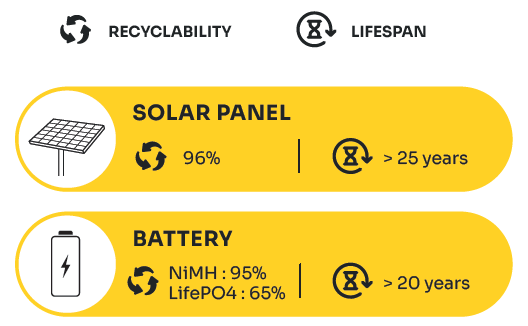

This approach helps reduce waste and promotes a practical circular economy.
Environmental performance does not rely solely on the product, but also on end-of-life treatment channels. Sunna Design relies on specialized partners to ensure the collection, processing and recovery of components: EcoLogic, Ecosystem, Corepile and Soren (French compagny)

This collaboration ensures compliant waste management (WEEE), traceability of flows and optimal material recovery.
Public lighting is entering a new era, where performance is no longer measured only in lux, but in overall impact. Integrating life cycle thinking into decisions means making a rational, economic and sustainable choice. In this context, autonomous solar lighting stands out as a highly relevant solution: not only to reduce emissions, but also to build more resilient and sustainable infrastructure over time.
Our experts can support you in designing a solution adapted to your technical, economic and environmental needs.