About solar lighting 8 December 2025
Every year, World Climate Day on December 8 reminds us not only of the urgent need to protect our planet, but also of the importance of reducing the inequalities exacerbated by global warming. Among the most visible consequences of climate change, energy fragility has become a key challenge: grid outages, storms, heatwaves, overloaded infrastructure… Access to reliable lighting then becomes a critical factor for safety, mobility and social cohesion. In this context, solar lighting stands out as an accessible, inclusive and sustainable solution capable of transforming daily life both in emerging countries and in developed regions.
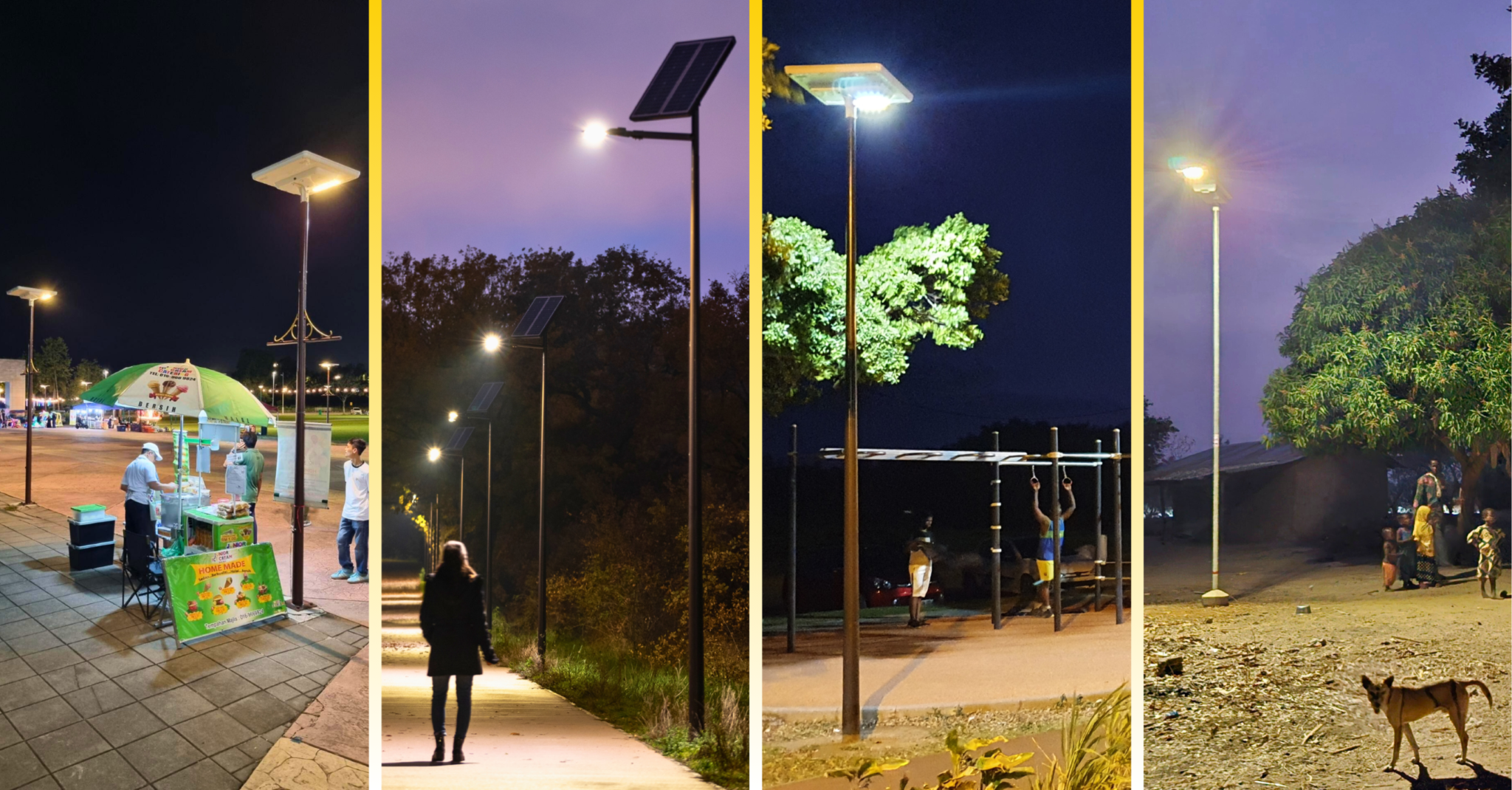
Reliable public lighting remains a global challenge. In many emerging countries, tens of millions of people still live in non-electrified areas. The absence of night-time lighting limits mobility, access to essential services, and personal safety. Infrastructure is often absent, costly to extend, or weakened by climatic hazards.
In developed countries, the situation is different: dependency on the electrical grid, ageing infrastructure, rising energy prices, and climate-related stress on networks. Storms and heatwaves, increasingly frequent, cause outages that can deprive entire neighbourhoods of essential services such as public lighting. In these very different contexts, a universal need remains: to see and move safely at night.
Public lighting is not just technical equipment. It is a genuine service of inclusion:
It secures night-time mobility, particularly for women and children.
It improves accessibility for elderly people and those with reduced mobility.
It strengthens social cohesion by enabling cultural or sports activities after dusk.
International development programmes often identify autonomous lighting as a high-impact social lever: increased use of lit public spaces, reduced accidents, and stronger local economic activity. A single light can transform daily life.
Climate disruption disproportionately affects vulnerable populations. A storm-damaged grid instantly plunges a territory into darkness. An extreme heatwave overloads networks and triggers outages. In contrast, solar lighting, fully autonomous, continues to operate, ensuring resilience and continuity of service.
General well-being: 91% of residents report an improvement in their quality of life.
Night-time activities: night-time attendance increased from 8% to 23%.
Access to essential services: +30% increase in night-time visits to health centres and water points.
Education: 25% of students now study in the evening (compared with 1% before).
Women’s inclusion & empowerment: 16% night-time outings, strengthening social participation.
Because it requires neither trenching nor grid connection, solar lighting enables the deployment of public infrastructure even in areas where the electrical network would not arrive for years. Territories once considered “too remote” or “too expensive to connect” can now access an essential service. Light once again becomes a matter of equal rights, not geography.
Public lighting can account for up to 40% of a municipality’s electricity bill. By eliminating grid electricity consumption entirely, solar lighting directly contributes to reducing CO₂ emissions. It is, by nature, a low-carbon solution:
Local authorities are increasingly exposed to climate events that disrupt their infrastructure. Solar lighting provides natural resilience:
operation even during outages,
intelligent energy storage,
systems designed to withstand extreme heat or storms,
reliable lighting even during extreme events.
Climate adaptation is not only about reducing emissions: it is also about ensuring continuity of essential public services.
Solar lighting integrates easily into climate plans, low-carbon strategies, SDG programmes and territorial resilience policies.
Its deployment is fast, controlled, and creates immediate impact on safety and quality of life.
In a world where climate change weakens infrastructure and deepens inequalities, solar lighting proves to be much more than a technological innovation: it is a tool for inclusion and resilience.
It brings light where it is lacking, strengthens safety, stimulates economic activity, and protects territories from climate hazards.
On World Climate Day, choosing solar lighting means changing lives — and enabling communities to become more sustainable, more equal and more resilient.
Solar lighting does not rely on electricity from the grid. It operates entirely on renewable energy produced and stored locally. This reduces CO₂ emissions linked to public lighting, which can represent a significant share of a municipality’s energy consumption.
Access to reliable evening lighting improves safety, mobility, and participation in community life. In vulnerable neighborhoods or isolated villages, solar lighting helps residents move safely, access essential services more easily, and maintain cultural, educational, or economic activities after dark.
Yes. In emerging countries, it addresses electrification challenges and improves access to basic services in areas not connected to the grid. In developed countries, it strengthens infrastructure resilience, reduces energy costs, and contributes to carbon reduction goals.
Yes. Solar streetlights are fully autonomous and do not depend on the electrical grid. During storms, heatwaves, load-shedding or grid failures, they continue to operate as long as their batteries are adequately sized and charged. Systems are designed to withstand severe weather conditions and ensure service continuity.
Where the electrical grid is absent, saturated, or too costly to extend, solar lighting enables the rapid deployment of autonomous lighting points. Rural villages, peripheral neighborhoods, or isolated sites can benefit from the same level of service as more central areas, helping reduce geographic disparities.
Our experts can support you in designing a solution adapted to your technical, economic and environmental needs.